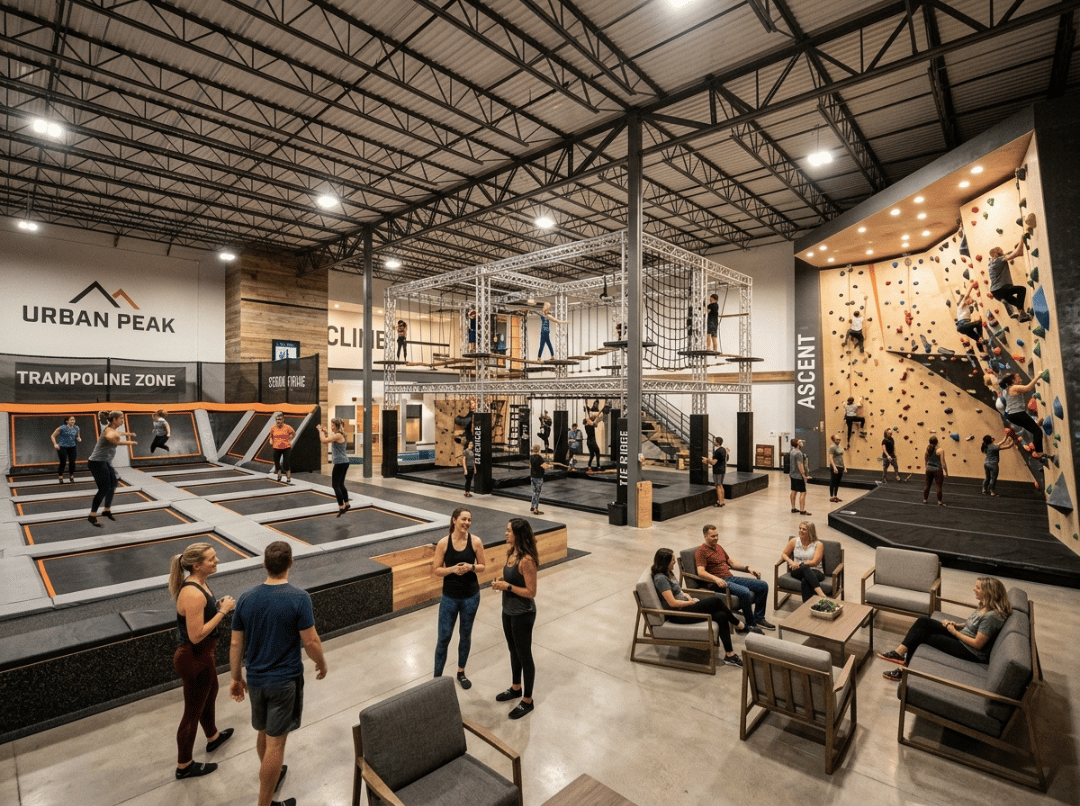
Adults have always played. What’s changed is that there’s now a commercial category built around it. Indoor playgrounds for adults—spaces engineered for grown-up physical activity, social challenge, and shared experience—have moved well past novelty. In high-traffic urban markets, they’re outperforming traditional gyms on dwell time, group spends, and repeat visits. In suburban FEC developments, they’re filling anchor slots that specialty retail can no longer hold.
This guide is for investors, operators, and developers deciding whether this model fits their situation. It covers what an adult indoor playground actually is, who the concept works for, how to plan the attraction mix and layout, what realistic budgets look like, and how to evaluate suppliers without making expensive mistakes.
What an Adult Indoor Playground Is — and What It Isn’t
An adult indoor playground is a commercial venue where grown-ups engage in physical play—trampolines, obstacle courses, climbing walls, VR movement zones, and similar active attractions—using equipment built for adult weight, intensity, and frequency of use.
That last part matters more than most operators realize before their first build. Adult-use equipment has different structural requirements than children’s play equipment: heavier steel gauges, higher anchoring loads, greater impact absorption capacity, and certification standards that reflect real athletic stress rather than casual child play.
You’ll see this concept positioned several ways depending on the operator’s target audience:
- Fitness-play hybrid — workouts that don’t feel like workouts
- Adult adventure park — obstacle and adrenaline-focused
- Social entertainment venue — competitive games, group activities, F&B-anchored
What it isn’t: a scaled-up version of a kids’ soft-play center. Operators who treat it that way typically underspecify equipment, overspend on renovation later, and create safety exposure in the interim.
Who This Business Model Actually Fits
Not every location or operator profile supports an adult indoor playground. Before committing capital, work through this honestly.
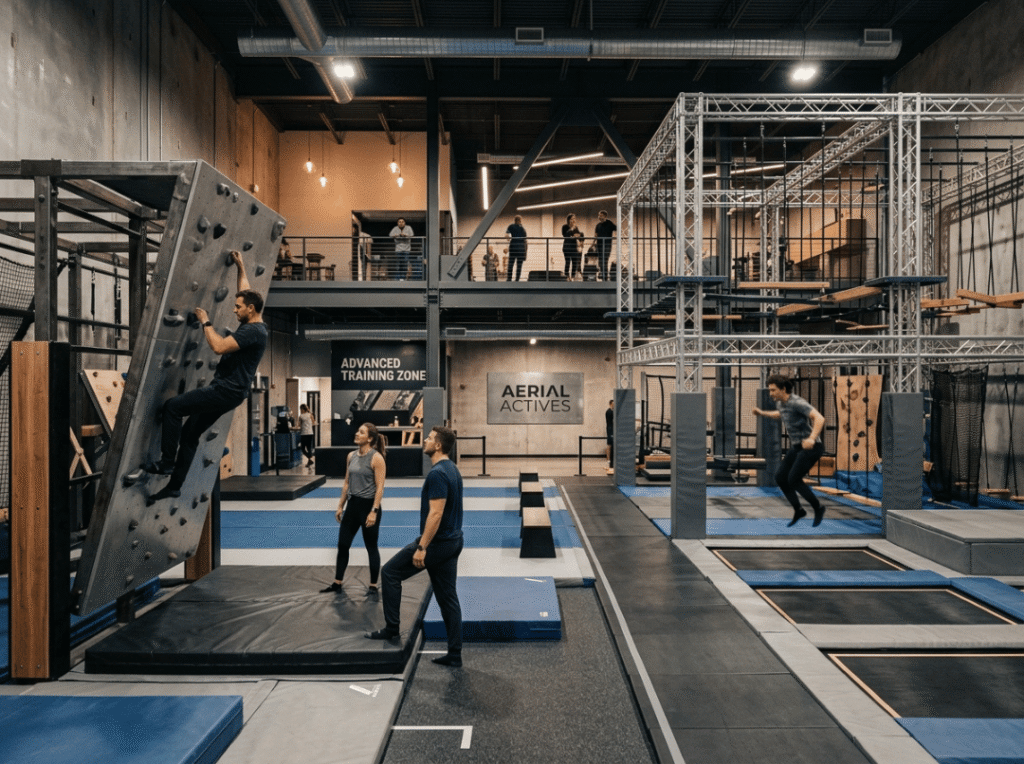
- Existing FEC and trampoline park operators are often the strongest candidates. You already run waivers, manage throughput, and understand how group dynamics affect revenue. Adding adult-specific zones—or converting evening hours to adult-only sessions—can materially lift revenue per square foot without a full venue rebuild.
- Retail landlords and mixed-use developers have been looking for anchor tenants that generate genuine foot traffic. An adult playground that draws evening and weekend visits—and keeps groups on site for two or more hours—does exactly what struggling retail cannot.
- Fitness entrepreneurs competing in saturated markets find that play-based fitness gives them a story that boutique gyms and cycling studios have difficulty copying. The obstacle course and the climbing wall are harder to commoditize than a spin bike.
- Corporate and hospitality operators near business districts benefit from a structural demand advantage: team-building bookings fill weekday afternoons, the revenue period that consumer-facing venues find hardest to monetize.
Who should be more cautious? Operators with limited capital reserves, no experience managing service-industry staffing, or venues in low-density markets where adult discretionary spending is thin. This is a high-capex, operations-intensive business. The venues that struggle usually either underbuilt the attraction mix or underfunded working capital before opening.
Which Attractions Drive Traffic, Repeat Visits, and Revenue — and Which Don’t
Choosing attractions is not a matter of fitting in as many as the floor plan allows. Every attraction should earn its square footage through one of four functions: drawing new traffic, sustaining engagement during the visit, generating repeat visits, or lifting per-guest spend.
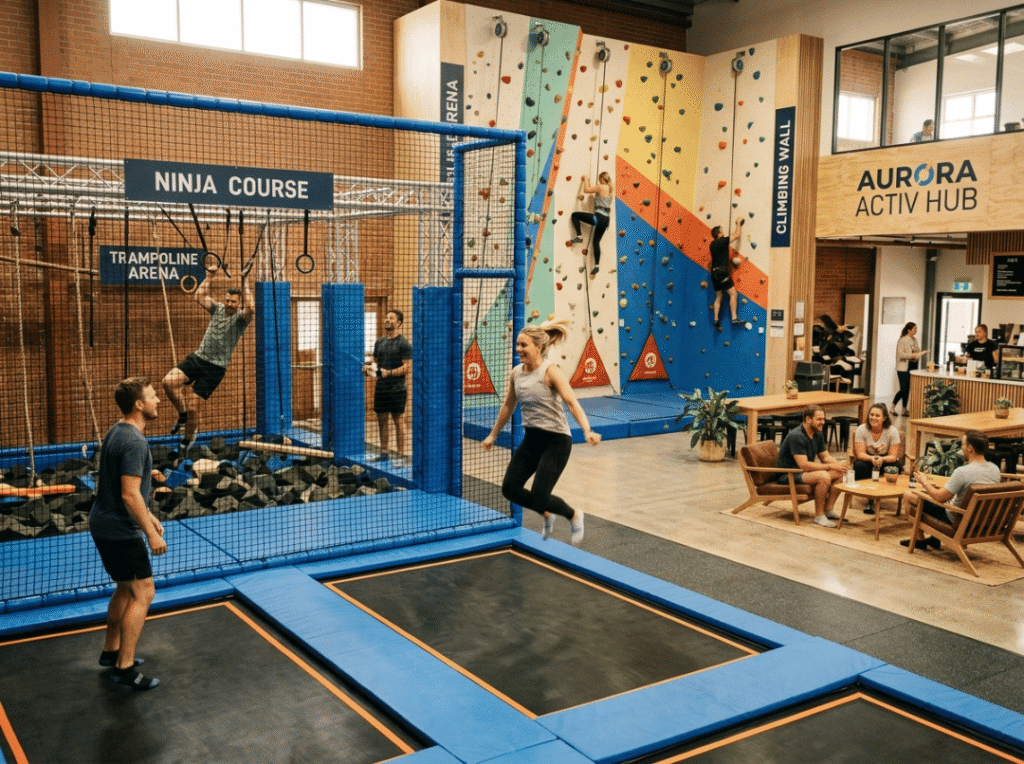
- Trampoline zones — interconnected jump courts, dodgeball, and foam-pit landings — are consistently the strongest traffic magnets. They’re broadly accessible, photograph well for social media, and generate enough word-of-mouth to anchor an opening. Nearly every profitable adult venue is built around trampolines as the primary draw.
- Ninja and obstacle courses work differently. They reward effort over time — guests come back to beat a section they failed last visit, or to improve their time. This is what drives membership conversions. The obstacle course is probably your strongest argument for a membership program.
- Climbing walls and bouldering follow a similar logic: clear skill progression, community formation, repeat visits. Climbers tend to come back weekly, book group sessions, and recruit friends who are new to the sport. Climbing also attracts a slightly older, higher-income segment than trampolines alone.
- VR and interactive digital zones deliver novelty and margin. Because content can refresh without rebuilding hardware, these zones can be rotated to create a reason to return. They also tend to appeal to guests who are less physically confident in obstacle or climbing environments — broadening your demographic.
- High ropes courses and zip lines require ceiling height and structural investment, but they generate standout marketing content and command premium pricing. Worth serious consideration in larger venues with the right building spec.
- Foam pits and battle beams serve as connective tissue — lower-intensity, high-fun elements that reduce the drop-off between harder attractions and keep groups moving together.
- Mini sports arenas (indoor soccer, basketball shootouts, dodgeball, table tennis) anchor corporate group bookings and are easy to package as team-building events with variable pricing.
- Social lounge and F&B areas are not an amenity. They are a revenue driver. Dwell time is directly tied to per-guest spend, and a lounge that gives people a reason to stay after physical activity meaningfully changes the economics of a session.
How to Build the Right Mix by Venue Purpose
A venue targeting general consumer traffic on evenings and weekends should lead with trampolines, support with obstacle or climbing, add VR or battle beams as secondary zones, and invest seriously in the social lounge.
A venue targeting corporate team-building should weight mini sports arenas and obstacle courses more heavily, since those experiences structure well as group challenges with clear outcomes.
A venue targeting fitness-conscious adults should prioritize climbing and obstacle elements with membership conversion built into the pricing model.
None of these profiles require everything. The mistake is designing for all of them simultaneously, which usually results in a layout that serves none of them particularly well.
Layout Planning by Venue Size
Layout shapes both safety and revenue. The right zoning keeps high-intensity areas from bleeding into recovery and spend zones, maintains sightlines for staff supervision, and creates a flow that moves guests through the space rather than clustering them in one area.
300–500㎡ — Compact Urban Venue
At this scale, constraint is your friend. Trying to fit too many attraction types creates a venue that feels crowded without feeling full — a difficult experience to price or to repeat.
The most effective compact format: one strong hero attraction (trampoline zone or tight ninja circuit), one secondary engagement element (climbing wall or foam pit), a modest social area with at least basic food and drink, and a clear reception and safety briefing zone near the entrance.
Lockers and restrooms should be positioned so they don’t break the guest flow to the main attractions. Supervision coverage is easier at this size, but it’s also where crowding becomes a problem fastest — timed sessions are essential.
500–1000㎡ — Standard FEC Format
This range supports a complete guest journey. A well-configured venue at this scale can deliver traffic attraction, skill-based engagement, novelty, and social spend in a coherent sequence.
A typical layout at this size: trampoline zone as the primary entry draw, a dedicated obstacle circuit as the core engagement area, a climbing or bouldering wall to anchor the skill-progression segment, a VR or interactive zone to add novelty, a central social lounge with proper F&B, and a private event room that can be sold as a party or corporate package.
Separate the high-intensity zones physically from the lounge area. Noise management and energy management both depend on this. Guests who want to eat, drink, or recover after activity need a space that doesn’t feel like the active floor.
1000㎡+ — Destination and Adventure Park Format
At destination scale, you’re building a venue people travel to specifically. That changes the economics: longer dwell times, higher per-visit spend, a broader attraction portfolio, and more complex staffing and operations.
The layout logic shifts from “one journey” to “multiple neighborhoods.” The trampoline area, obstacle complex, climbing zone, and sports courts each function as distinct destinations within the venue. The VR zone or a signature attraction — a long zip line, a warped wall you can actually train on — becomes the shareable hero. F&B transitions from lounge to a proper bar or café.
Multiple event rooms matter at this scale, because corporate and private hire bookings become a meaningful revenue segment. Prioritize flexible spaces that can convert between classroom-style team briefings, seated dining, and open floor space.
One consistent principle across all three sizes: the high-visibility positions in the layout should go to your highest-margin zones. A VR experience near the entrance performs differently than one tucked behind the obstacle circuit.
What a Realistic Budget Covers
Costs depend on location, building condition, ceiling height, and the specific attraction mix. What’s consistent is which line items surprise operators who haven’t built one of these before.
- Equipment is typically the single largest cost. Adult-rated attractions are priced significantly above comparable children’s equipment because of structural requirements, certification standards, and the engineering needed to handle repeated high-intensity adult use. The gap between equipment marketed as “adult-suitable” and equipment actually designed for adult loads is commercially significant — the former tends to fail in ways that generate both maintenance cost and liability.
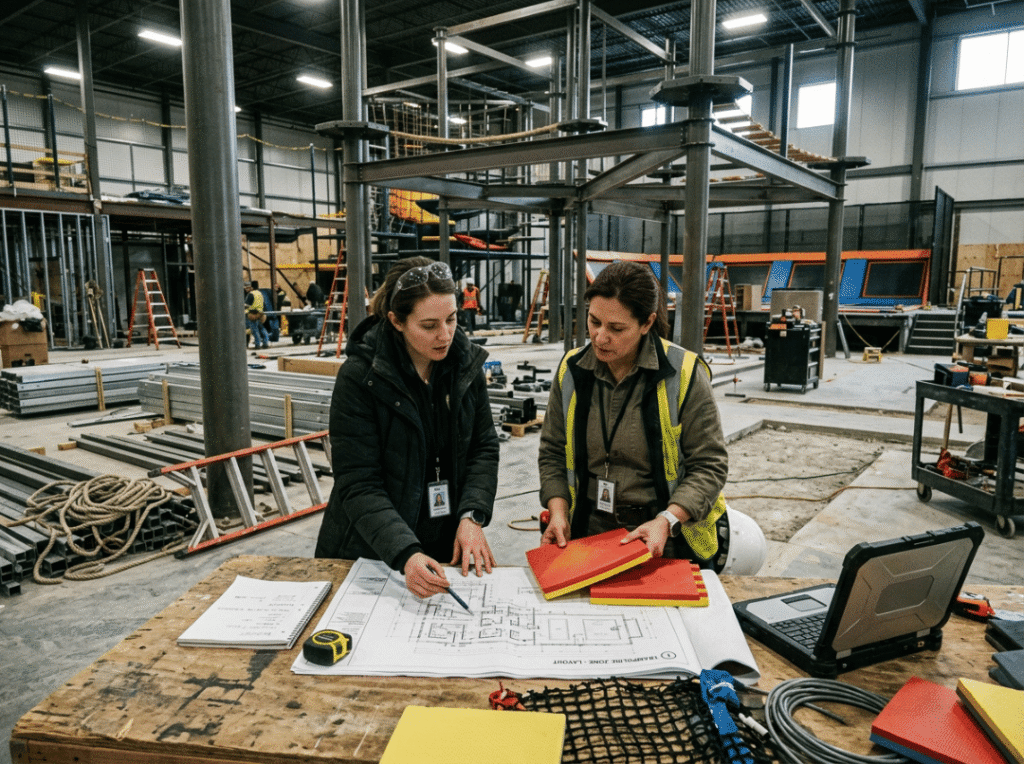
- Installation is not a minor addition to equipment cost. Complex elements — high ropes, zip lines, large trampoline systems — require structural anchoring, professional rigging, and third-party inspection before opening. Budget for this explicitly rather than treating it as part of equipment pricing.
- Site preparation covers flooring, impact surfacing, padding, HVAC upgrades, lighting, restrooms, and often ceiling reinforcement if you’re installing elevated elements. Older or previously retail-configured buildings consistently generate higher site costs than initial estimates. Add a 10–20% contingency for this category specifically.
- Safety systems — netting, harness anchors, fall zones, signage — are non-negotiable and non-negotiable in a specific way: the cost of doing this correctly is always lower than the cost of the incident that results from doing it poorly.
- Staffing and training before opening is real cost. You need monitors who understand both the equipment and the risk profile of adult guests before the doors open, not after.
- Insurance and permits should be scoped early. Liability coverage for active-entertainment venues at adult intensity is meaningfully more expensive than general commercial liability. It also affects your pricing model — know this number before you finalize ticket pricing.
- Working capital beyond the build covers pre-opening marketing, initial payroll, and operating reserve for the first several months. Most venues that fail financially were not unviable — they were underfunded at opening.
What Actually Drives Profitability
A common misconception is that ticket revenue is the core business. It isn’t — it’s the entry point. Profitable venues are built on layered revenue, not admission volume alone.
- General admission (usually sold in timed sessions) provides baseline throughput. Timed sessions also manage safety and experience quality, both of which affect the probability of a return visit.
- Memberships and passes convert your most engaged guests into predictable recurring revenue. The obstacle course and climbing wall are the strongest membership drivers — they create a practice-and-progress model that generic admission can’t fully satisfy.
- Corporate team-building is structurally valuable because it occupies weekday afternoon capacity that consumer traffic doesn’t fill. A venue that builds a corporate program is effectively running two businesses with one facility.
- Private events — birthdays, celebrations, company parties — offer premium pricing and strong F&B attachment. They also generate marketing reach through the guest lists.
- Food and beverage margin is often underestimated. A guest who stays on site for two hours and has a drink or a meal contributes significantly more than a guest who completes their session and leaves. Layout decisions that extend dwell time directly improve F&B revenue.
- Retail and ancillary services — grip socks, coaching sessions, branded merchandise — add incremental margin without requiring additional floor space.
The scheduling strategy that holds this together: consumer sessions on evenings and weekends, corporate and group bookings on weekday afternoons. Venues that don’t actively sell corporate and group packages are leaving the most financially attractive capacity slot mostly empty.
Safety and Operations: What Breaks First
Safety in an adult venue requires specific attention precisely because adults feel more confident taking risks than children do. That confidence is the hazard.
- Equipment certification for adult use is the baseline. Request documentation that specifies load ratings, testing standards, and the certification body. “Adult-suitable” without documentation is a liability waiting to materialize.
- Impact protection — foam pit depth, padding specifications, certified surfacing under elevated elements — should be specified and installed before opening, not adjusted after an incident.
- Waivers and zone rules need to be enforced consistently, not just posted. Operators who treat waivers as legal protection rather than behavior-setting tools tend to have more incidents.
- Staff supervision at adult venues differs from children’s play centers in one critical way: adults will attempt things beyond their ability more readily, and they’re heavier when they fall. Active supervision — monitors who intervene before problems, not after — is a material part of your injury prevention program.
- Inspection schedules should be documented, not ad hoc. Daily visual checks plus periodic structural inspections create the paper record that matters both operationally and legally.
- Capacity management through timed sessions is not just a revenue tool — it’s the most effective single mechanism for reducing crowding-related incidents.
Operationally, track three metrics consistently: throughput per session, average dwell time, and revenue per guest. These three numbers will tell you, with reasonable precision, whether your layout and pricing are functioning — and which specific area to address if they aren’t.
Adult Indoor Playground vs. Kids Indoor Playground vs. Trampoline Park
Understanding the differences between these formats matters because they affect capital requirements, staffing models, insurance costs, and peak revenue periods.
|
Factor |
Adult Indoor Playground |
Kids Indoor Playground |
Trampoline Park |
|---|---|---|---|
|
Primary audience |
Adults, groups, corporates |
Children and parents |
Mixed ages, teens/young adults |
|
Equipment spec |
Heavy-duty, adult weight-rated |
Lightweight, soft, child-scale |
Trampoline-focused, moderate rating |
|
Intensity level |
High, athletic |
Low, exploratory |
Medium to high |
|
Peak revenue window |
Evenings, weekends, weekday corporate |
Daytime, weekends, parties |
Weekends, after school |
|
Spend per guest |
Higher (F&B, events, memberships) |
Moderate |
Moderate |
|
Supervision requirements |
High; active adult-specific protocols |
High; child-safety focused |
Moderate to high |
The critical distinction for capital planning: adult equipment is not a specification upgrade from children’s equipment. It’s a different product category, with different engineering, different certification paths, and different consequences when it’s the wrong choice.
How to Evaluate Equipment Suppliers
The supplier you choose affects construction timelines, equipment longevity, safety compliance, and your ability to expand or reconfigure later. Evaluating suppliers only on unit price is the most common mistake in this category.
The questions that reveal the most:
- Is this equipment actually certified for adult weight and intensity, or is it children’s equipment with adjusted marketing? Request the specific certification, the certifying body, and the load ratings. If a supplier hesitates to provide this documentation, that’s your answer.
- Do they offer custom configuration, or only standard products? An adult indoor playground that fits your floor plan, ceiling height, and traffic flow requires custom design. Standard kits built for a different footprint create compromises that affect both safety and revenue.
- What does their project scope include — design, installation, training, post-installation support? Suppliers who hand off after delivery leave operators managing problems they’re not equipped to solve. Look for a manufacturer that provides custom design-to-installation services as an integrated offering.
- Can they show completed projects with verified references? A portfolio of installed adult venues, with operators you can contact, is meaningfully different from renders and a product catalog.
- What are the lead times, warranty coverage, and spare-parts model? A venue that can’t get replacement parts for a popular attraction loses revenue every day it’s closed. Understand the maintenance supply chain before you sign a contract.
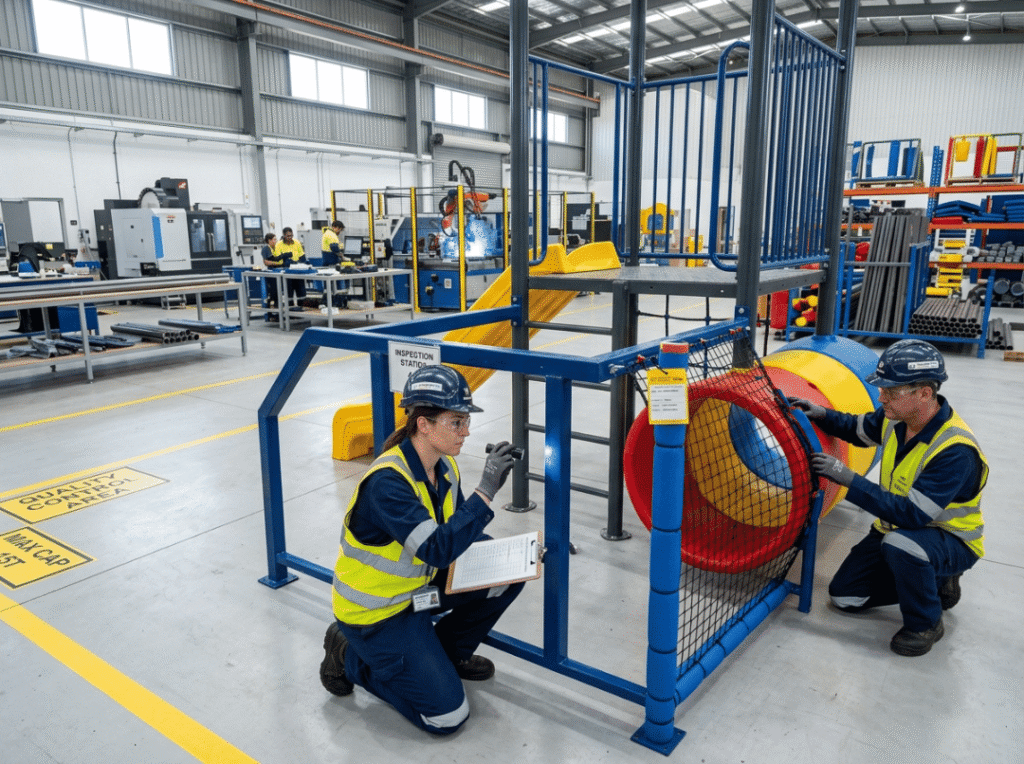
Inqila’s manufacturing and factory capabilities are built specifically around this kind of custom commercial brief — ISO9001-certified production, adult-spec materials, and project support from design through installation. That matters because the quality decisions made in production are much harder and more expensive to correct after installation than before it.
FAQ
How much does it cost to build an adult indoor playground?
Total cost depends on venue size, building condition, ceiling height, and attraction mix. Equipment is typically the largest single line item, followed by site preparation and installation. Always include a 10–20% contingency for renovation surprises, and maintain operating reserves for at least the first several months after opening.
Are adult indoor playgrounds profitable?
Yes, when the revenue model is layered. Admission alone rarely carries a venue to profitability. The operators who consistently perform well combine session tickets with memberships, corporate team-building packages, private events, and food and beverage revenue — and actively fill weekday capacity with group bookings.
What equipment should an adult indoor playground include?
Start with one strong traffic-driving attraction — usually a trampoline zone or hero obstacle course. Add 2–3 engagement-focused elements that reward return visits, such as a ninja circuit or climbing wall. Include one high-margin novelty like VR, and invest seriously in the social lounge and F&B area. The combination of traffic, engagement, and dwell-time conversion is what separates performing venues from those that plateau.
How much space do I need?
A focused concept can launch in 300–500㎡ with one hero attraction and supporting elements. A full-experience venue typically requires 500–1000㎡. A destination-scale adventure park needs 1000㎡ or more to support multiple signature zones, event rooms, and complete F&B.
What are the most important safety requirements?
Equipment must be certified for adult weight and intensity — documented, not just claimed. Impact surfacing and padding specifications must be installed to standard before opening. Waivers should be enforced as behavior guidelines, not just legal paperwork. Staff should actively supervise rather than monitor passively. Timed sessions manage capacity and are your most effective injury-prevention tool.
Conclusion
Adult indoor playgrounds work when the concept is matched to a realistic market, the attraction mix is built around clear revenue logic, the budget accounts for all the line items that surprise first-time operators, and the equipment is genuinely specified for adult use.
The venues that underperform usually share one of a few common problems: too many attraction types without enough depth in any of them, underinvestment in the social and F&B areas that drive per-guest spend, equipment that wasn’t built for adult loads, or a revenue model that relied on admission volume rather than layered income streams.
If you’re in the planning stage, the sequence matters: define your target customer and venue size first, build the attraction mix around that customer’s actual behavior, design the layout to move them toward high-margin zones, and then choose a supplier who can deliver adult-rated, custom-configured equipment with full installation support.
Getting those decisions right at the start is considerably less expensive than correcting them after opening.