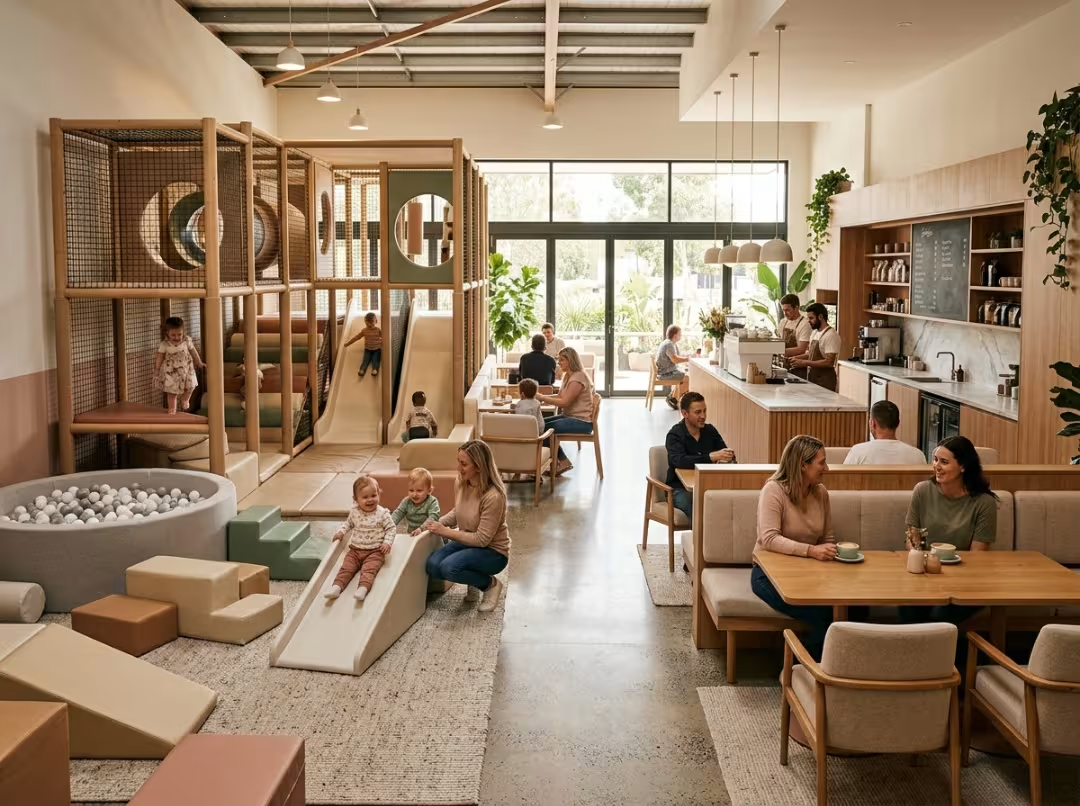
Starting a profitable play café requires four structural decisions made before you invest in design or equipment: validate the local market, choose a business model, design the space around parents’ sightlines and labor efficiency, and select equipment based on certification and payback logic. Startup costs for a 3,000–5,000 sq ft space typically range from $199,000 to $488,000+.
Most people who open a play café spend the first six months making the wrong decisions — not because they lack passion, but because they make them in the wrong order. They fall in love with a color scheme before they’ve confirmed the market can support their pricing. They sign a lease before deciding whether they’re running a neighborhood café or a party-led venue. By the time equipment arrives, the layout no longer fits the model.
This guide is structured around the decisions that actually determine whether a play café survives its first two years. Four of them happen before a single dollar goes toward decor or equipment. Get those right, and the operational details become much easier to manage. Skip them, and no amount of pastel paint will save you.
The focus here is practical and at the operator level. This isn’t a general overview of the play café industry — it’s a working framework for first-time operators who want to build something profitable from the start.
1. Validate the Market Before You Design Anything
Most operators skip this step because it feels slow. It isn’t. A market validation mistake is the one that costs you the lease deposit, the build-out, and two years of your life.
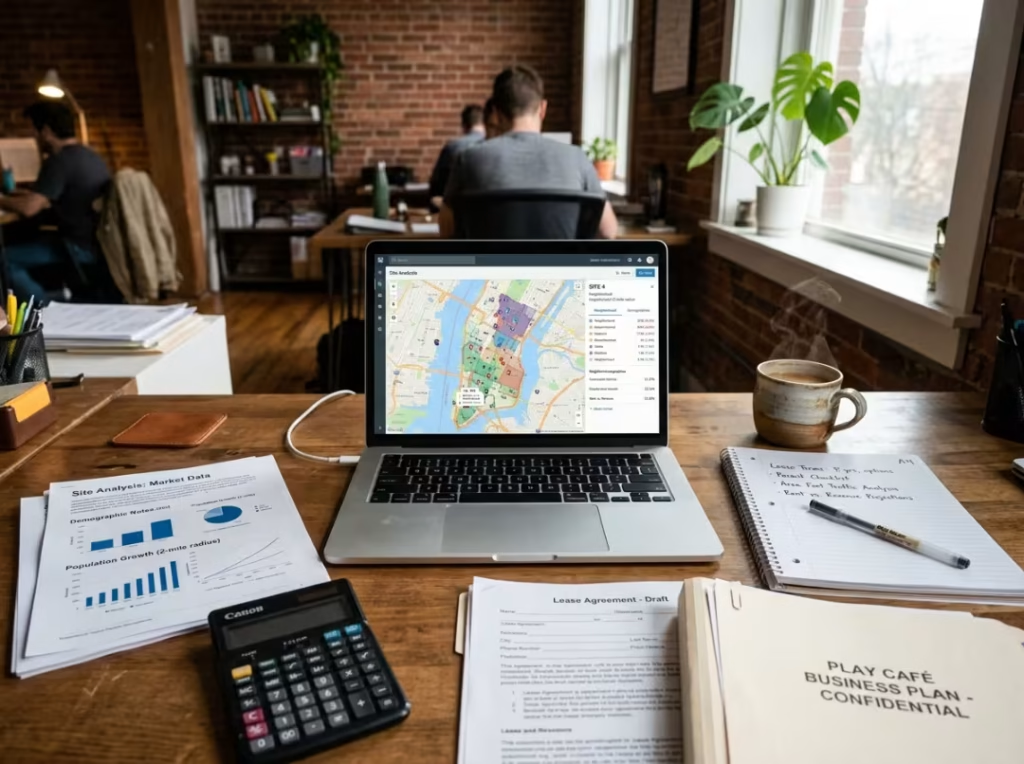
What household density actually tells you
Play cafés run on repeat visits from families with young children, typically ages 1–6. That means your real addressable market isn’t “everyone within 10 miles” — it’s households with children under 6, within a 10–15 minute drive or a walkable radius in urban areas.
A rough benchmark: a neighborhood play café targeting 150–250 memberships needs a local population of at least 8,000–12,000 households within the primary catchment, with a meaningful proportion of families in that age bracket. Census data, local school enrollment figures, and tools like Esri’s demographic reports can give you this. If the density isn’t there, no amount of marketing will manufacture a customer base that doesn’t exist.
How to evaluate local competition by quality, not count
Counting nearby play cafés tells you almost nothing. What matters is whether the existing options are actually good. A market with two mediocre competitors is an opportunity. A market with one well-run, well-loved play café with 300 active members is a different situation entirely.
Visit competitors as a customer. Look at their cleanliness, sightline design, café quality, membership pricing, and how full their parking lot is on a Tuesday morning. Read their Google reviews for patterns, not just star ratings. If the consistent complaint is “the café is bad” or “it’s too cramped for toddlers,” those are gaps you can fill. If reviews uniformly say “we love it and come every week,” you need to understand why — and whether you can genuinely differentiate.
Location type and lease terms
Strip malls with strong anchor tenants (grocery stores, pediatric clinics, children’s dance studios) outperform standalone locations and lifestyle centers for play café concepts. Foot traffic matters less than proximity to your repeat-visit customer’s weekly routine. A location near a pediatrician’s office or a daycare pickup route is worth more than a high-traffic corner that attracts passersby who aren’t your customer.
On lease terms: negotiate tenant improvement allowance (TIA) aggressively before signing. Build-outs for play cafés are expensive, and a landlord offering $30–50/sq ft TIA on a 3,000 sq ft space can cover $90,000–$150,000 of your construction costs. Also pay close attention to co-tenancy clauses, HVAC responsibility (this is significant — more on this later), and exclusivity provisions if you’re in a multi-tenant center.
2. Choose Your Business Model Before Finalizing the Layout
Three distinct play café models exist, each requiring a different physical layout, staffing approach, and revenue structure.
The neighborhood repeat-visit model runs on membership revenue and relies on proximity, community atmosphere, and consistent quality. It targets local families who visit two to three times per week. The café and soft seating are as important as the play floor.
The mall or high-traffic model relies on impulse visits and walk-ins. It requires high visibility, a fast check-in process, and an experience compelling enough to justify stopping mid-shopping trip. Margins per visit are lower; volume is the engine.
The party-led model treats birthday parties as the primary revenue driver and structures every other element around that. Party rooms take prime square footage. Admission and café sales are secondary.
For first-time operators, the most resilient financial structure combines the neighborhood and party-led models. Memberships provide a revenue floor — predictable monthly income that covers fixed costs even during slow weeks. Birthday parties deliver the highest gross margins of any revenue stream, typically 60–70%, with minimal incremental labor cost when your space is already staffed.
The critical point: your model must be decided before layout planning begins. A party-led café needs 20–25% of its square footage allocated to party rooms, dedicated storage for supplies, and a separate entrance or flow path so parties don’t disrupt the general admission experience. A neighborhood model needs comfortable adult seating with sightlines, a real café counter capable of handling volume, and quiet corners for parents who want to work. These are structurally incompatible if you try to retrofit one onto the other.
3. Design the Space Around Parent Sightlines and Labor Efficiency
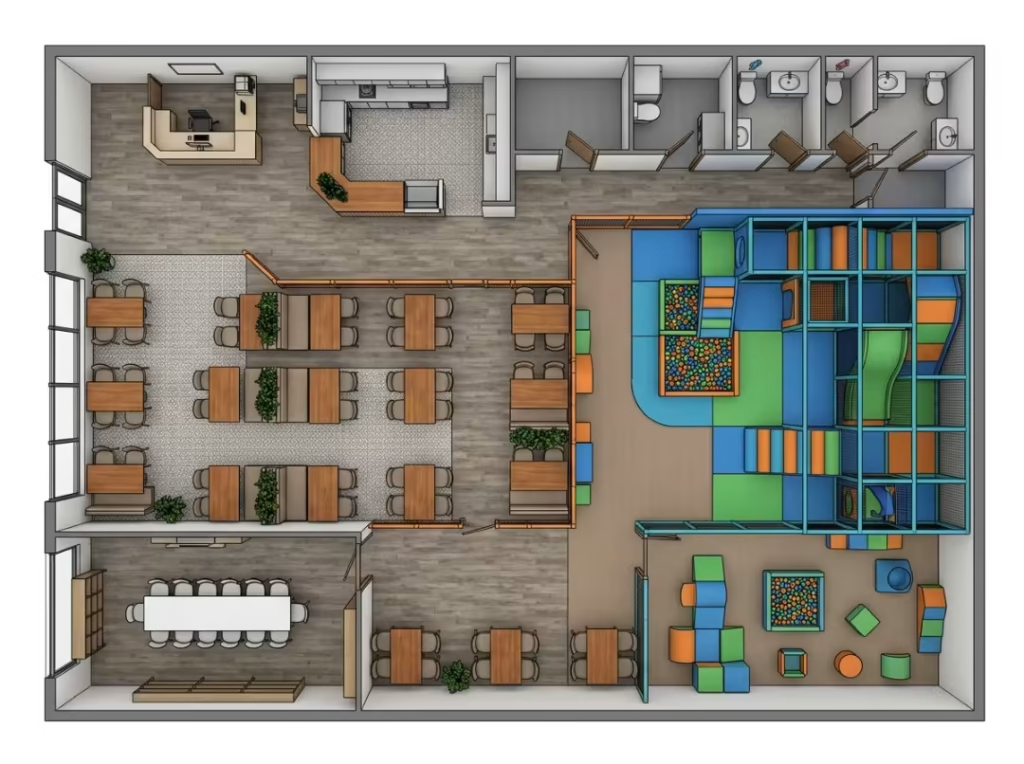
Sightlines are the core design constraint
Parents will not sit at your café counter if they can’t see their child. That sentence contains more design guidance than most interior consultants will give you.
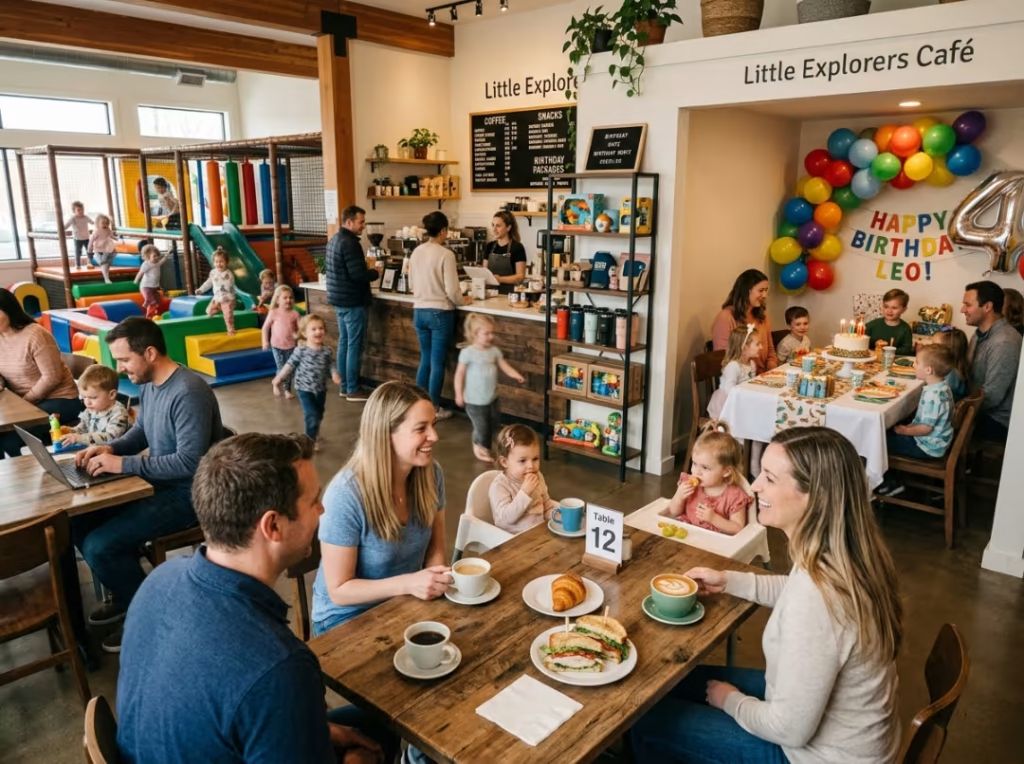
The entire seating layout for adults must be positioned with direct visual access to the play floor. This isn’t a preference — it’s what keeps parents longer, orders more coffee, and makes them feel comfortable enough to book a membership. Obstructions (structural columns, high shelving, equipment with tall walls) must be mapped against sightlines before any furniture is placed. In a correctly designed play café, a parent seated anywhere in the café zone can see at least 80% of the play floor without standing up.
Age-zoning with physical barriers
The play floor should be divided into at least two age zones — typically 0–2 and 3–6 — separated by a low physical barrier (30–36 inches) rather than by signage alone. This protects toddlers from older, faster-moving children, reduces supervision stress for parents, and allows you to manage different risk profiles within the same space.
The under-2 zone should be soft-surface-only: foam climbers, sensory panels, and soft blocks. No hard edges, no elevated structures above 18 inches. The 3–6 zone can incorporate structured climbing, slides, and imaginative play elements. For spaces with budget to accommodate it, a third zone for ages 5–8 with a modest challenge element (a small multi-level climber or obstacle course) meaningfully extends your target demographic.
Square footage allocation benchmarks
For a 3,000–5,000 sq ft play café:
- Play floor: 40–50% — the single largest investment in experience
- Café and adult seating: 30–35% — where revenue per visit and membership satisfaction are built
- Party room(s), storage, check-in, bathrooms: 20–25% — operational necessity, not an afterthought
Operators who give the play floor 65%+ of the space consistently underperform on café revenue and membership renewal, because parents don’t have a reason to linger. The café experience isn’t a supplement to the play experience — it’s the product parents are actually buying.
Design for labor efficiency from day one
A play café with 2,500 sq ft of active floor space that requires four staff members to supervise safely will consistently lose money on weekday mornings. Design the layout so one or two staff members can maintain full visual coverage of the space from a single position, ideally near the check-in desk.
Keep the café counter in the same sightline zone as the play floor — not separated by a wall or corridor. This allows a single staff member to manage café service and play floor supervision simultaneously during low-traffic hours.
Budget for acoustic treatment at build-out
This is consistently underestimated and consistently regretted. Hard floors, hard walls, and 30 children equal a noisy environment that drives parents out within 45 minutes. Panel acoustic absorption on at least 30% of wall surface area in the play zone, plus a cloud ceiling treatment above the main climbing area, makes a measurable difference in dwell time and parent satisfaction. Budget $8,000–$18,000 for this at the build-out stage. Retrofitting acoustic treatment after opening costs more and looks worse.
4. Select Equipment Based on Certification, Payback Logic, and Maintenance Cost
Certification standards that matter
For commercial play café equipment in the US, three certifications are non-negotiable from an insurance and liability standpoint:
- ASTM F1951 — accessibility standard for surfacing under and around play equipment
- ASTM F3101 — soft contained play equipment standard (directly applicable to soft play structures in play cafés)
- EN1176 — the European standard, increasingly referenced by US insurers for commercial play installations
Any supplier who cannot provide documentation for these standards on specific product models should be removed from consideration. Certifications are not interchangeable — verify that the certification applies to the exact model being quoted, not just the brand’s broader product line. INQILA’s indoor playground equipment meets EN1176, CE, and ISO 9001 standards, making it a verifiable option for operators requiring documented compliance.
Payback by equipment category
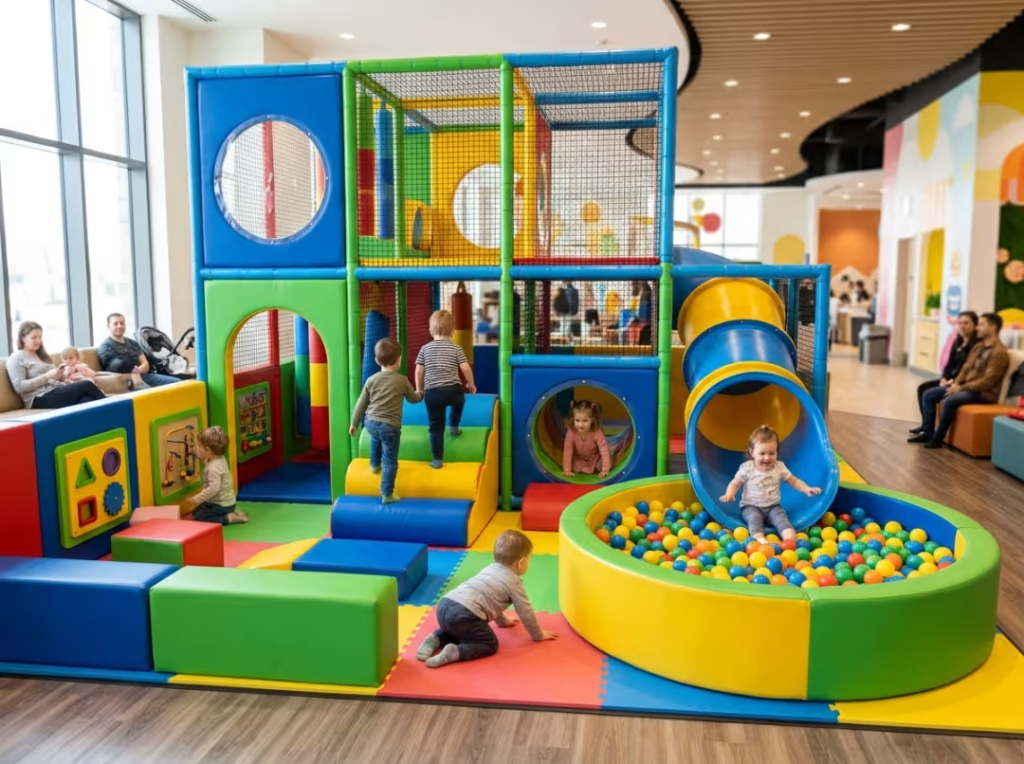
Not all play equipment pays back at the same rate. Soft play structures — foam climbers, ball pits, sensory panels — have the lowest per-unit cost, the lowest maintenance burden, and the highest utilization among the 0–4 age group that forms your core demographic. They should form 60–70% of your play floor investment.
Modular climbing structures with slides have higher upfront cost and higher maintenance requirements, but they’re the element parents photograph and share. One well-designed centerpiece climbing structure at the 3–6 zone anchor position drives word-of-mouth at a rate that justifies the cost. Budget $15,000–$35,000 for this element depending on size and customization.
Interactive technology elements (projection floors, sensory walls) have the highest cost and the widest variance in utilization. For first-time operators, treat these as Phase 2 additions once membership revenue is stable.
Modular vs. custom for first-time operators
Custom equipment is compelling in renderings and almost always the wrong choice for a first build. Lead times run 12–20 weeks, modification after installation is expensive, and you won’t fully understand your customers’ usage patterns until you’ve operated for three to six months.
Modular systems allow reconfiguration as you learn. A toddler zone that isn’t getting used can be swapped out for sensory panels without a structural contractor. For first-time operators, modular equipment from a certified supplier is the lower-risk, faster-to-open choice.
Long-term maintenance cost considerations
The cost of play equipment doesn’t end at purchase. Factor in: foam replacement cycles (high-density foam in climbing structures needs partial replacement every 18–24 months in high-traffic installations), upholstery cleaning and patching (budget 2–4 hours of staff time per week), fastener inspections (monthly), and surface flooring replacement (EVA foam tiles typically last 3–5 years under commercial use).
When comparing equipment bids, ask each supplier for their recommended maintenance schedule and the cost of replacement parts. A structure that’s $4,000 cheaper upfront but requires proprietary parts available only through the original supplier — with a 6-week lead time — is not actually cheaper.
5. Build a Profit Structure Across All Four Revenue Streams
A play café with only admission revenue is a fragile business. The four-stream model — admissions, memberships, birthday parties, and café sales — creates financial resilience because each stream has a different demand curve and a different margin profile.
Admissions: your discovery mechanism
Walk-in admission is how new customers discover you, not how you make money. Price it at $12–18 per child (varies by market and square footage), keep the check-in process frictionless, and treat every admission visit as an opportunity to convert to membership.
Staff who can articulate the membership value proposition during check-in — without a hard sell — are worth training specifically on this. The conversion from first visit to membership is your single most important early-stage metric.
Memberships: your revenue floor
Monthly memberships priced at $60–90 per family provide predictable income to cover fixed costs. A target of 150–250 active memberships at $75/month generates $11,250–$18,750/month in recurring revenue before any walk-ins or party bookings.
Reaching 150 memberships typically takes 4–8 months of operation. During that ramp period, your admission and party revenue carries more weight. Structure membership tiers simply: one household tier, one multi-child tier. Complexity kills conversion.
Membership churn is your biggest long-term risk. Track it monthly. If month-over-month churn exceeds 5%, investigate the cause before layering on acquisition marketing — you’re filling a leaky bucket.
Birthday parties: your highest-margin revenue
Birthday party packages at $350–600 generate 60–70% gross margins when structured correctly. The cost of goods (decorations, dedicated staff time, party supplies) is predictable and low relative to the package price. A two-hour party slot on a Saturday afternoon generates more gross profit than three hours of general admission.
Most play cafés undercharge on parties. If your Saturday party slots are fully booked six weeks out, your pricing is too low. A two-room party configuration with premium package options at $550–600 can support 6–8 parties per weekend at maturity.
Café revenue: the parent experience anchor
A focused café menu — quality espresso drinks, a small selection of food for adults, and basic snacks for children — averaging $8–12 per adult visit is both achievable and necessary for dwell time. Parents who have a genuinely good coffee won’t leave after 45 minutes. They’ll stay for two hours and bring a friend next week.
Don’t over-engineer the menu. Four espresso drinks, two non-coffee options, two food items for adults, two for children. That’s a café that a single barista can run efficiently during moderate traffic periods. A complex menu creates bottlenecks, increases training time, and raises food waste.
How the four streams reinforce each other
Admission converts to membership. Membership creates the steady audience for birthday party bookings (parents with memberships trust the venue and book parties there). Café quality drives dwell time, which increases the chance of membership conversion and party upsells. Each stream feeds the others — which means weaknesses in one stream don’t just hurt that stream, they suppress the others.
6. Plan Startup Costs — Especially the Ones Nobody Warns You About
Full cost table for a 3,000–5,000 sq ft play café
|
Cost Category |
Estimated Range |
|---|---|
|
Leasehold improvements / build-out |
$60,000–$150,000 |
|
Play equipment |
$40,000–$90,000 |
|
Café equipment (espresso machine, refrigeration, POS) |
$15,000–$35,000 |
|
Furniture (adult seating, tables, check-in desk) |
$8,000–$20,000 |
|
Acoustic treatment |
$8,000–$18,000 |
|
Flooring (EVA foam tiles, café area) |
$10,000–$25,000 |
|
Permits, inspections, and licensing fees |
$5,000–$20,000 |
|
HVAC upgrades |
$10,000–$40,000 |
|
Signage and branding |
$4,000–$12,000 |
|
Initial marketing and pre-launch |
$5,000–$15,000 |
|
Working capital (3 months of operating expenses) |
$34,000–$63,000+ |
|
Total estimated range |
$199,000–$488,000+ |
The four most underestimated cost categories
HVAC. A play space with 30–50 children in a sealed room generates enormous heat and CO₂ load. Standard residential or light commercial HVAC systems are almost always inadequate. Upgrading to a system capable of proper air exchange in a high-occupancy play environment typically costs $10,000–$40,000 and is often not included in initial contractor bids unless you specifically ask.
Acoustic treatment. Covered above — but worth repeating here because it reliably appears as a surprise cost after opening when operators realize their space is unusable at full capacity without it.
Permits and inspections. Food service licensing, building permits, fire marshal inspections, health department certification, and ADA compliance review collectively cost more and take longer than most first-time operators expect. In some jurisdictions, this process adds 8–16 weeks to your timeline. Budget $5,000–$20,000 and start the process before you finalize your opening date.
Working capital. The first three months of operation will not cover fixed costs. Membership ramp takes time. You need three months of rent, payroll, and operating expenses in reserve before opening — not as a line of credit you hope to access, but as cash on hand.
7. Operational Principles That Protect Your Margins
Staff for visibility, not just headcount ratios
Staffing ratios (e.g., “one staff member per 15 children”) are a liability minimum, not an operating standard. What matters is whether every part of the play floor is visually covered by a staff member at all times. A layout that requires four staff for safe coverage during peak hours needs to be redesigned, not over-staffed.
Cross-train staff on café service and play floor supervision. On slow weekday mornings, a single experienced employee should be able to manage both. On Saturday afternoons, you may need three or four. Schedule to demand, not to a fixed ratio.
Cleanliness as a competitive differentiator
In a category where parents make repeat-visit decisions based on hygiene, cleanliness is a competitive advantage rather than a baseline expectation. Staff should conduct visible cleaning rounds every 30–45 minutes during operating hours. Foam surfaces should be wiped down with child-safe disinfectant at closing every day. Ball pits — if you have them — need a documented weekly sanitization protocol.
Parents notice. They talk about it. A play café known for being genuinely clean will outperform a flashier competitor that isn’t.
Peak hour management and check-in friction
Saturday mornings from 9 AM to 12 PM will represent a disproportionate share of your weekly revenue. Any friction at check-in during these windows — slow waiver processing, POS system delays, staff uncertainty about capacity limits — compounds quickly into a poor first impression.
Implement digital waivers collected during online booking. Pre-assign party arrival windows so birthday groups don’t arrive simultaneously with general admission. Cap walk-in capacity 20% below your physical maximum to maintain experience quality.
8. Compliance Checklist
Before opening, confirm the following are complete:
- Zoning approval for a commercial play and food service use in your specific location
- Food service license from your local health department
- Play equipment certification documentation (ASTM F3101, EN1176 as applicable) on file and available for insurance review
- Fire code compliance — occupancy load posting, emergency exit signage, fire suppression if required
- ADA accessibility — accessible entrance, bathroom, and at least partial access to the play environment
- Business liability insurance with a play facility rider — minimum $1M per occurrence, $2M aggregate is standard; some landlords require $3M
- Signage compliance — age and height restrictions posted at each zone entrance, capacity limits at entry
Some jurisdictions require a separate commercial kitchen inspection even for a limited café menu. Confirm this with your local health department before build-out, as it affects your kitchen design requirements.
9. Pre-Launch Checklist
8–12 Weeks Before Opening
- Finalize lease and begin permit applications
- Place equipment orders (allow 15–20 weeks for certified commercial play structures)
- Build your website and set up online booking
- Begin pre-launch membership waitlist with a founding member discount
4–8 Weeks Before Opening
- Complete staff hiring and begin training
- Finalize café menu and establish supplier relationships
- Conduct a full compliance inspection walkthrough
- Launch social media and local marketing (neighborhood Facebook groups, parent forums, local parenting publications)
1–3 Weeks Before Opening
- Soft-open with invited families for 2–3 test sessions — use real children, real mess, real volume
- Stress-test check-in, café service, and party room setup simultaneously
- Confirm all certifications and insurance are active
- Brief staff on membership conversion language and party upsell process
Opening Week
- Staff a dedicated check-in position at all times for the first two weeks
- Collect email addresses at every visit — your membership marketing list is being built right now
- Respond to every Google and social media review within 24 hours
Frequently Asked Questions
How much does it cost to open a play café?
For a 3,000–5,000 sq ft play café, total startup costs typically range from $199,000 to $488,000+, depending on location, build-out complexity, and equipment choices. The largest variables are HVAC, leasehold improvements, and working capital reserves. Budget conservatively — most first-time operators underestimate costs by 15–25%.
How long does it take to break even?
Most well-run play cafés reach operational break-even (monthly revenue covers monthly fixed and variable costs) within 12–18 months. Reaching full investment payback typically takes 3–5 years. Operators who launch with a strong founding membership waitlist and a booked party calendar can significantly shorten the break-even timeline.
Are birthday parties worth the space investment?
Yes — at 60–70% gross margin, birthday parties are the highest-margin revenue stream in a play café. A two-room party configuration running 6–8 parties per weekend at $450–$600 per package can generate $10,800–$19,200/weekend in party revenue alone at full capacity. Allocating 15–20% of your square footage to dedicated party space is almost always justified.
What are the most common reasons play cafés fail?
Three patterns appear consistently: undercapitalization (insufficient working capital to survive the membership ramp period), choosing a location based on rent rather than household density, and failing to differentiate in a market with an established competitor. Business model ambiguity — trying to be both a mall walk-in venue and a neighborhood membership café — is a fourth, often overlooked cause.
Do I need food service experience to run a play café?
No, but you need to understand food service economics and hire accordingly. A café that serves mediocre coffee or slow service will undermine your dwell time and membership retention in ways that are hard to trace back to the root cause. Hire an experienced barista for your lead café role, even if you’re running a simple menu.
What is the minimum footprint for a viable play café?
2,500 sq ft is the functional minimum for a neighborhood model without party rooms. To support birthday parties as a meaningful revenue stream, 3,500–4,000 sq ft is a more realistic lower bound. Below 2,500 sq ft, you’re operating a soft play corner with a coffee machine — a different business with a different economics profile.
Does café quality really affect overall profitability?
Yes, meaningfully. Dwell time is directly correlated with per-visit café revenue and membership conversion. Parents who stay 90 minutes spend more at the counter and are more likely to purchase a membership than parents who leave after 45 minutes. Café quality is not a soft amenity — it’s a financial lever.
What insurance does a play café need?
At minimum: commercial general liability with a play facility endorsement (most insurers require this specifically), commercial property insurance, workers’ compensation, and product liability if you manufacture or significantly modify any play equipment. Standard minimums are $1M per occurrence / $2M aggregate, though many landlords require $3M. Expect annual premiums of $8,000–$18,000 depending on square footage, location, and claims history in your area.
Four Decisions That Determine Everything
A play café doesn’t succeed or fail at the grand opening. It succeeds or fails in the four months before construction begins — in the market validation data you gather, the business model you commit to, the spatial design choices you make, and the equipment you select. Get those four decisions right, and the operational details become solvable problems. Skip them, and you’ll be solving the wrong problems with money you don’t have.
The concrete next step: before you look at another available retail space, pull the household density data for your target area. If the population of families with children under 6 within a 15-minute drive supports 200+ memberships, you have a market to work with. If it doesn’t, no amount of good design will change that math.
For more on designing a space that works operationally from day one, see Mastering Indoor Playground Design. For a deeper look at the profitability of indoor play centers, Is Running an Indoor Play Center Profitable? A 2026 Guide covers the financial structure in detail.