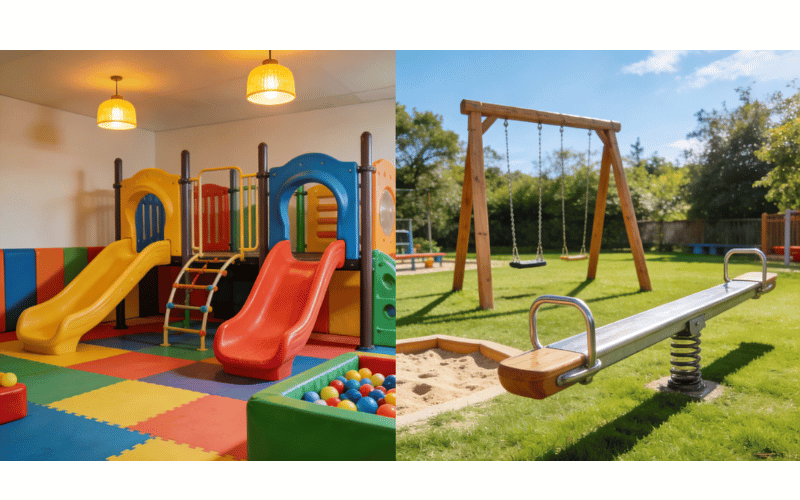
Know the difference between indoor and outdoor playgrounds to better inform your choice.
The march toward creating engaging play spaces for children gives consumers lots of options, but makes selecting the best one a bit more complex. Where a buyer may have once decided between a simple swing set and a more elaborate climbing frame, now there’s the added consideration of weather protection, supervision needs, and environmental integration.
Two such play options—indoor and outdoor playground equipment—share many goals, including promoting fun and activity, but are suited to different uses and buyers. Understanding the differences can help you make the choice that’s best for your needs.
Indoor Playground Equipment Explained
While more and more commercial spaces offer some level of integrated play, indoor playgrounds go all the way, creating self-contained worlds of fun protected from the elements. Sometimes referred to as family entertainment centers (FECs) or soft play areas, they have at least one major structure that invites children to climb, slide, and explore.
The main environmental advantage of an indoor playground is its year-round availability, free from the constraints of rain, snow, or extreme heat. In almost all cases, they also drastically cut the risk of certain injuries, thanks to controlled access, soft flooring, and padded surfaces. On the technical side, an indoor playground has fewer parts exposed to corrosive elements, and it provides an instant attraction that results in brisk (and often addictive) customer traffic. They’re also contained and easier to supervise, which gives off a secure and professional vibe.
That said, indoor structures are constrained by ceiling height and floor space, and a larger, more elaborate design further increases initial setup costs, making large-scale indoor parks comparatively tough on budgets. This is mostly a future consideration for those who purchase a used playground, because new equipment from a reputable supplier is covered by warranty for manufacturing defects.
There’s also the environmental impact of the materials themselves to consider, as many plastics and foams used in these large structures are produced through industrial manufacturing. However, these impacts are diminishing as material technology improves and recycling programs for these components become more common.
Outdoor Playground Equipment Explained
Outdoor playgrounds are sometimes thought of as the best of both worlds when it comes to active fun, packaging physical challenges with the benefits of fresh air and nature. They use an open environment with one or more structures that can generate excitement, recapture a sense of adventure, and spark children’s imaginations, with or without specific theming. The child decides which combination of activities is best for the current moment, so you may see a transition from swinging to sliding or back again.
But the combination of natural elements and man-made structures makes for a complex maintenance challenge. Most outdoor playgrounds rely on durable materials like metal and treated wood to withstand the elements, with plastic components there to provide some color and specific play functions. They augment the natural landscape by adding challenges or letting kids run free in a more open setting.
Compared to indoor playgrounds, outdoor sets have fewer size restrictions and can be as large as the available land allows. The environmental impact of their daily operations is relatively low, yet they still rely on manufactured materials. There are variations on that theme, chief among them the nature-inspired playground, which adds natural elements like logs and boulders to a larger playscape for extended free-play between structured activities.
Deciding Between Indoor and Outdoor Playground Equipment
Outdoor playgrounds, especially the community park sort, are a great traditional option for those interested in but not yet sold on the indoor business model. An outdoor setup lets you dabble in providing play, both for public use and private events, while still carrying the weather-dependent risk of rainy days or times when you just can’t find a break in the forecast. If you live in a temperate climate or have access to a large plot of land, a “traditional” outdoor playground will give you the flexibility you may need while still being a valuable community asset.
When you’re ready to go all-in on a weatherproof business, the expanding array of indoor equipment offers compact, toddler-focused, multi-level, and teen-oriented options, as well as some that do double duty. Choice can be overwhelming, but there’s something for every entrepreneur in the future of indoor play.