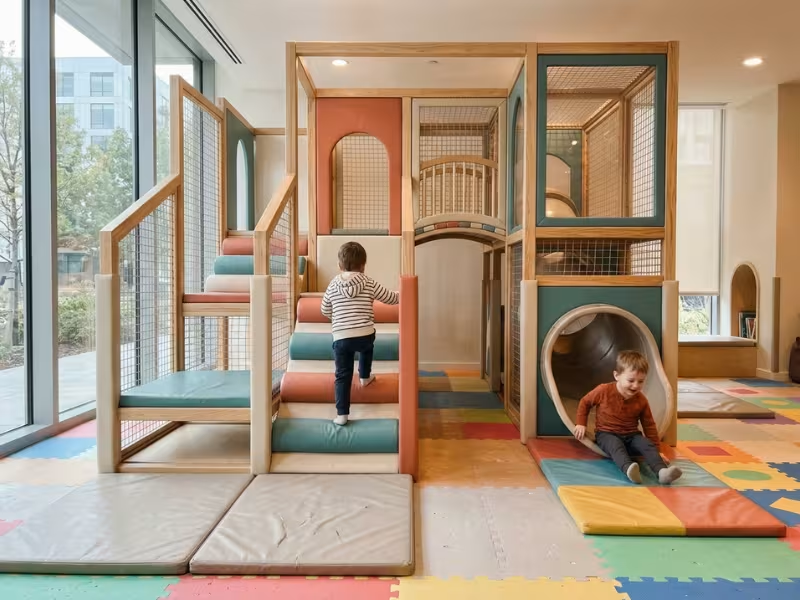
Rain cancels the park trip. Summer heat or winter cold keeps everyone inside. Darkness arrives before dinner. Your kids still need to run, climb, and burn off energy.
Many parents face this every week. The right indoor play area activities can fill that gap. You don’t need a big house or expensive gear.
I help families turn ordinary rooms into play spaces their kids actually use. In this guide, I’ll show you how to choose activities based on four things: energy level, available space, your child’s age, and how much mess you can handle.
How to Choose the Right Indoor Play Area Activities
Most parents start by asking, “What can my kids play?” I suggest a better first question: “What do I need this hour to do?”
A wild toddler at 4 p.m. needs to burn energy. A child home sick needs something calm. Two cousins on a rainy Saturday need a shared game. Once you pick the goal, the right activity becomes much easier to spot.
Next, look honestly at your space. A hallway works for tape-line games. A living room corner can hold a fort. A basement can handle a full obstacle course.
Then decide how much mess you can live with today. Sensory bins keep kids busy for a long stretch, but you will find rice in the rug later.
Age matters too. Toddlers do best with short, simple tasks and lots of repetition. Older kids want rules, challenges, and a chance to win. The same balloon game can work for both if you change the rules.
|
Goal |
Best activity types |
Space needed |
Noise/mess level |
|---|---|---|---|
|
Burn energy |
Obstacle courses, balloon games, mini relay races |
Medium |
Medium |
|
Encourage imaginative play |
Forts, pretend play stations, indoor camping |
Low to medium |
Low to medium |
|
Keep kids busy independently |
Sensory bins, craft trays, building stations |
Low |
Medium |
|
Support group play |
Scavenger hunts, team challenges, movement games |
Medium to high |
Medium |
Use this table as a quick filter. Match your goal first. Then check whether your space and mess tolerance fit before you set anything up.
Best Indoor Play Area Activities for Burning Energy
When kids start bouncing off the walls, they need something real to bounce toward. These three activity types give you the most movement for the least setup, so I always start families here.
Obstacle Courses That Work in Real Homes
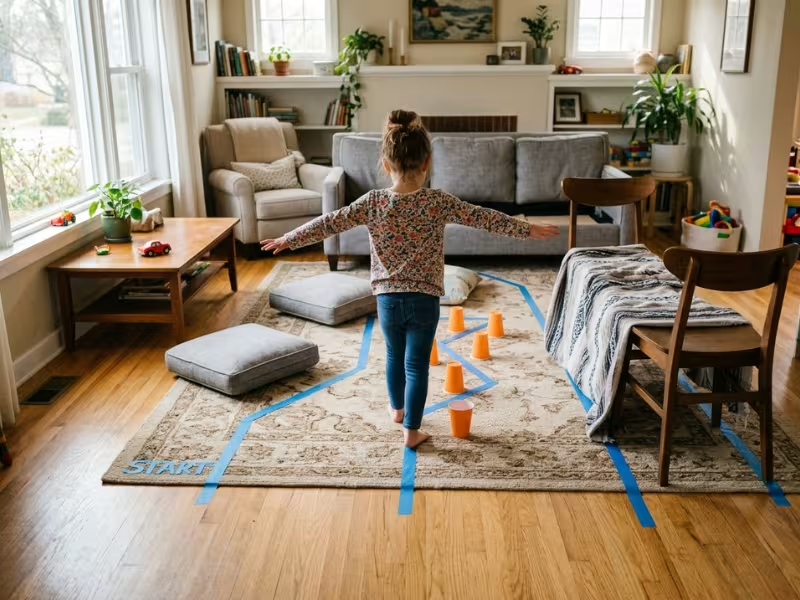
If I could pick only one high-energy activity, I’d pick an obstacle course. It makes kids jump, crawl, balance, and plan a route all in one loop. That mix tires out the body and the brain at the same time.
You don’t need a big room. A living room works well for a loop. A hallway gives you a natural straight line. A basement lets you go bigger.
Build it from what you already own:
- Couch cushions to jump between
- Painter’s tape lines to walk like a balance beam
- Paper cups to weave around or knock over
- Soft stools or ottomans to step up and down
- A blanket over two chairs to crawl through
Adjust the course by age. Toddlers need four or five stations and a clear path. Preschoolers can handle simple rules like “hop on one foot here.” Kids six and up love a timer and a new twist each round, such as carrying a stuffed animal the whole way.
Safety comes first. Lay cushions on a rug or mat, not bare wood or tile. Leave at least an arm’s length of open space at every turn. Move coffee tables and anything with hard corners out of the route.
Balloons, Soft Balls, and Target Games
Few activities give you more movement for less effort. A pack of balloons or a set of foam balls costs a few dollars and fits in a drawer. Setup takes under a minute.
Soft options matter indoors. A balloon floats slowly, so kids chase it, reach, and jump without breaking a lamp. Foam balls bounce off walls and faces without harm. Save hard rubber or plastic balls for outside.
Match the game to the age:
- Ages 2–4: Target toss into a laundry basket. Move the basket closer so they win often.
- Ages 4–7: Bowling with empty water bottles. Kids set pins, roll, and reset, which keeps them moving between turns.
- Ages 6 and up: Balloon volleyball over a string or the back of a couch. Add a rule: the balloon can’t touch the floor, and nobody can hit it twice in a row.
Keep a paper scoreboard nearby. Older kids will play twice as long when they can track points.
Indoor Movement Gear Worth Considering
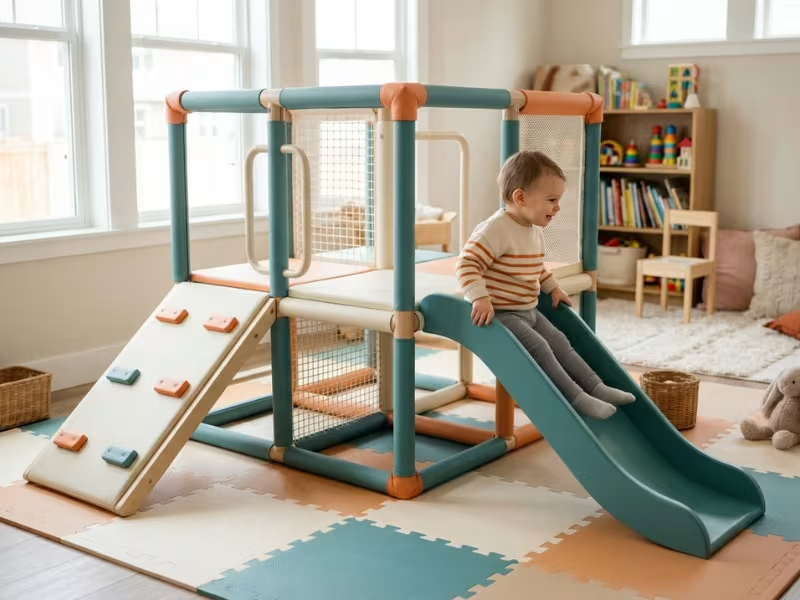
Household items take you far. Still, a few pieces of gear earn their spot, especially if indoor days stretch for months where you live. Families with a dedicated playroom may also look at indoor playground equipment when they want a more permanent setup with climbing, sliding, and active play built into one zone.
These are the pieces I see families actually use:
- Foam blocks: Kids build, climb, and rebuild. They work from toddler years through early school age.
- Balance beam: A low, padded beam builds coordination and slides under a couch when playtime ends.
- Foldable slide: Great for toddlers who want to climb and slide all day. For a dedicated zone that sees heavy daily use, a fixed stainless steel slide holds up better over the long term.
- Climbing triangle: Ideal for active kids ages 1–5 who already climb your furniture.
Buy gear if your kids play inside most days, you have a corner that can hold it, or you have more than one child to share it. Skip it if you have one older child, little storage, or a play center nearby that you visit often.
Before you buy, check four things:
- Does it fold or nest? If you can’t tuck it away, it will turn into clutter.
- Will it grow with your child? Pick gear that works for at least two age stages.
- Does it carry a safety certification? In the U.S., look for ASTM and CPSC compliance on the label.
- What footprint does it need? Measure your space, and include clearance around the gear.
Start with one piece. Watch how your kids use it for two weeks before you add another.
Indoor Activities That Build Imagination, Not Just Movement
Not every indoor hour needs to be loud. Kids also need play that lets them invent stories, solve small problems, and slow their bodies down. These setups give them that without much extra work from you.
Pretend Play Setups Kids Keep Coming Back To
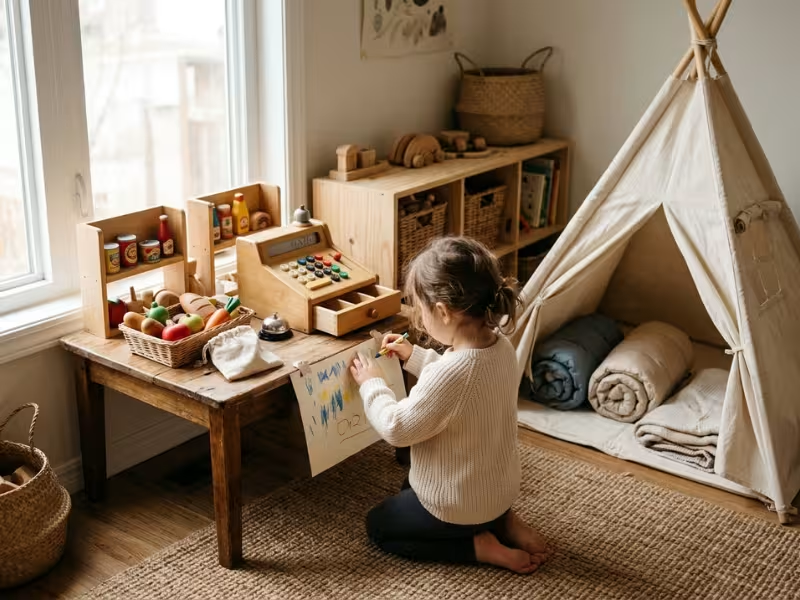
Forts, indoor camping, and role-play corners all spark big stories. A blanket fort turns into a castle. A tent with flashlights turns into a campsite. A small table turns into a bakery.
Placement makes the real difference. Kids usually tear down a one-off fort by dinner and rarely ask for it again. A fixed theme corner stays in the same spot for a week or two. Kids know where it lives, so they return to it on their own.
Kitchen, store, and doctor stations rotate well because they share the same base. One small table and a low shelf can switch roles in five minutes. Swap the play food for a cash register and price tags. Later, swap those for a toy stethoscope and bandages.
I also tell parents to stop before the scene looks finished. Set up the tent but leave the sleeping bags folded. Open the store but let the kids make the signs. A half-set-up scene gives children a job, and that job pulls them into the story faster than a perfect display does.
Arts, Crafts, and Sensory Play Without Losing the Room
Messy play is worth it, but only when you control where the mess can go. I call this contained messy play.
Give every messy activity a clear border. A rimmed baking sheet, a shallow storage bin, or a cheap shower curtain under the table all work. The rule stays simple: materials stay inside the edge.
Then match the materials to the surface:
- Daily use, any room: crayons, washable markers, stickers, play dough, kinetic sand in a lidded bin
- Cleanable surfaces only: paint, water play, glitter, dry rice or beans, slime
Make cleanup part of the activity. Hand your child a small brush and dustpan at the start, not the end. Kids accept cleanup much better when they know it’s coming.
Music and Movement for In-Between Moments
Some gaps feel too short for a full setup. Think of the ten minutes before lunch, or the wait while a sibling finishes homework.
Music fills those windows well. Play freeze dance, lead a round of follow-the-leader with silly moves, or hand out pots and wooden spoons for a kitchen band. You need no prep and no cleanup.
Treat these games as a bridge. They help kids shift gears between a busy activity and a calm one.
Once you know which kinds of play your kids enjoy most, the bigger question becomes where it all fits in your home.
The Best Indoor Play Activities by Space Type
Most guides sort indoor play area activities by type. In real homes, the room shapes play more than the activity list does. A great obstacle course fails fast if it blocks the path to the kitchen.
Start with the space you actually have. Here is how to match play to three common home layouts.
Small Apartment or Limited Floor Space
In a small apartment, use length and height instead of floor area. A hallway is your best asset. Run a painter’s tape line down the middle for balance walks, hopscotch, or a lava-floor race.
Balloons work well here because they move slowly and rarely break anything. Keep a few in a zip bag near the door.
Use your walls for storage. A hanging shoe organizer holds balls, tape, and scavenger hunt cards. Choose gear that folds flat, like a play tunnel, and slide it under the bed afterward.
If setup takes more than two minutes, it won’t happen on a busy day.
Living Room Corner or Shared Family Space
This room belongs to everyone, so play has to share it. Claim one corner, not the whole floor. A rug marks the zone, and toys stay on it.
Pick activities that pack away in under five minutes. A cushion-and-tape obstacle course works. So do pretend play bins: one for kitchen toys, one for doctor tools.
Keep two or three baskets out at a time. Store the rest in a closet and swap them weekly. Kids treat a returning basket like a new toy.
Playroom, Basement, or Dedicated Zone
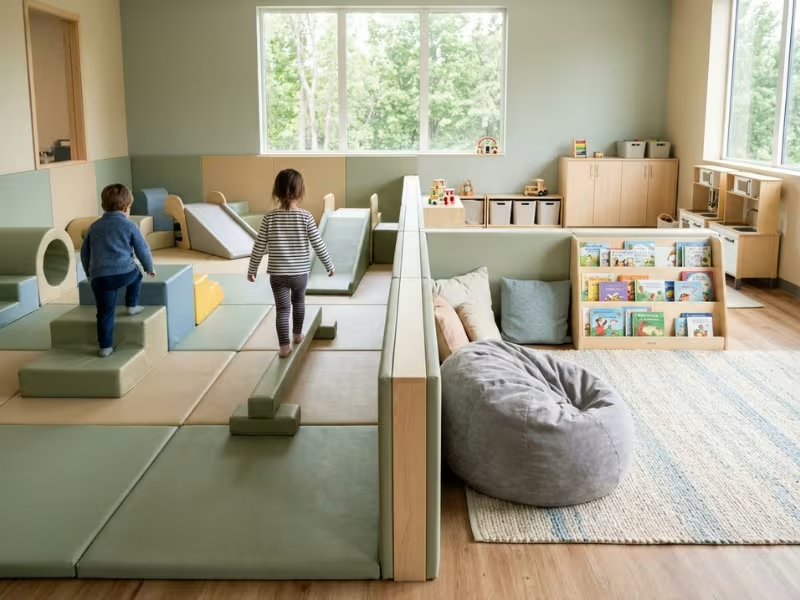
A dedicated room lets you leave bigger gear set up. Climbing triangles, foam blocks, and low balance beams earn their price here because kids use them without waiting for setup.
Organize the room into stations, not piles. Give each station one job, such as climbing, building, art, or reading. Label low shelves with pictures so toddlers can clean up alone.
Split the room into two zones. Put the active zone on soft flooring with open space. Put the quiet zone in a corner with a beanbag and books. A clear boundary keeps climbers away from readers.
The same layout principles work well in daycare rooms, kids’ clubs, and small indoor play businesses. If you’re planning a long-term space like that, custom playground equipment can make the layout safer, easier to maintain, and better matched to the room.
Don’t fill every wall. Open floor is your most useful equipment.
|
Space type |
Best activities |
What to avoid |
|---|---|---|
|
Small apartment |
Tape games, balloon play, scavenger hunts |
Large ride-on toys |
|
Shared living room |
Foldable obstacle course, pretend play bins |
Permanent bulky equipment |
|
Dedicated playroom |
Climbing gear, sensory station, rotation shelves |
Overcrowding the room |
How to Set Up an Indoor Play Area That Stays Useful
Many play areas look great on day one and sit empty by week three. The toys rarely cause the problem. The setup does.
Three choices keep your space safe, fresh, and worth the money. Get them right, and your kids will keep coming back.
Start with Safety and Layout
Walk the room at your child’s eye level before you add anything. You’ll spot sharp corners and wobbly shelves you never noticed.
Keep a clear path at least three feet wide through the active zone. Kids run in straight lines and rarely look down.
Put soft flooring under anything kids climb or jump from. Foam tiles or a thick rug work well. Hardwood and tile don’t forgive a missed landing.
Anchor every bookcase, dresser, and tall shelf to the wall. Taller furniture can tip if children climb it, so wall anchors are worth adding before you build any active play zone.
Match the challenge to the child. Toddlers need climbs under two feet. Older kids need a harder task, or they’ll invent riskier ones.
Buy Less, Rotate More
A packed room overwhelms kids. They dump bins, wander off, and lose interest. Fewer choices lead to longer, deeper play.
I recommend a weekly activity basket system. Pick three to five core activity types and give each one a basket:
- Movement: balls, tape, beanbags
- Building: blocks, magnetic tiles
- Pretend play: kitchen or doctor kit
- Art or sensory: crayons, play dough
- Quiet: books, puzzles
Leave two or three baskets out each week. Store the rest out of sight. Swap them on the same day, like Sunday night, so it becomes a habit.
When a basket returns after two weeks away, kids greet it like a new toy.
What to Buy vs What to Improvise
Think of your play area in two layers. The base layer is gear you buy once and use for years. The top layer changes often, so you build it from what you have.
Spend money where safety and durability matter:
- Foam floor tiles or mats
- Furniture wall anchors
- A certified climbing triangle or balance beam
- Sturdy, low storage shelves
Improvise anything kids will outgrow, wreck, or tire of:
- Target toss with a laundry basket and rolled socks
- Painter’s tape lines for paths and hopscotch
- Paper clues and a shoebox for treasure hunts
- Blankets, clothespins, and chairs for forts
My rule stays simple. If it holds a child’s weight or prevents a fall, buy quality. If it only sparks an idea, make it.
With a solid setup at home, you can judge when an indoor play center actually adds something new.
Home Setup vs Indoor Play Centers: Which Makes More Sense?
Parents often ask me whether they should build a play space at home or buy a pass to the local play center. I tell them it isn’t an either-or choice. Each option solves a different problem.
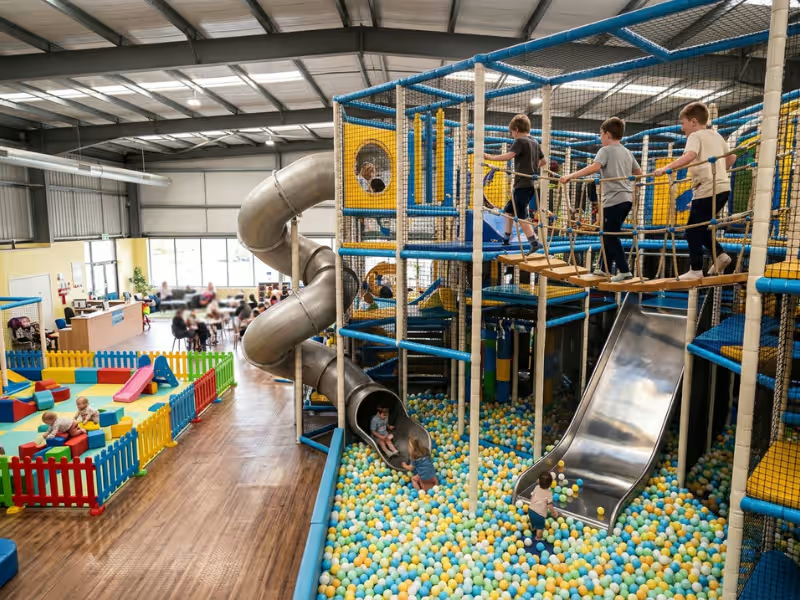
A home setup handles the daily routine. It’s there at 7 a.m., on a sick day, and in the 20 minutes before dinner. An indoor play center handles the big days. It gives kids tall climbing structures, ball pits, and other children to chase.
|
Option |
Best for |
Pros |
Trade-offs |
|---|---|---|---|
|
Home setup |
Daily use, younger kids, flexible routines |
Convenient, customizable, lower long-term cost |
Limited variety, requires setup and cleanup |
|
Indoor play center |
Occasional high-energy outings, social play, bad-weather weekends |
More equipment, more novelty, less home mess |
Cost, travel, overstimulation, hygiene concerns |
Before you commit to a membership, do the math. Divide the yearly price by the number of visits you’ll realistically make. If you go fewer than twice a month, single-day passes usually cost less.
Visit once at the time you’d normally go. A center that feels calm on a Tuesday morning can turn chaotic on a Saturday afternoon.
Check the basics while you’re there:
- A separate zone for toddlers
- A posted cleaning schedule
- Staff who actually watch the floor
- Sock and age rules that everyone follows
Then use two simple rules.
Choose a home setup when you need play that happens often, starts fast, and repeats easily, such as a daily energy burn without packing a bag.
Choose an indoor play center when your kids need a big physical outlet, new friends to play with, or you need a break from cleaning up your own living room.
Most families do best with both. Keep a simple home setup for weekdays. Save the play center for one or two trips a month.
Common Indoor Play Problems and What Actually Helps
Even a solid plan runs into real life. These four worries come up with almost every family I work with, and each one has a simpler fix than most parents expect.
“My house is too small.”
A small home doesn’t stop play. It just changes direction, so look up and look long.
A hallway makes a perfect track for crab-walk races, long-jump contests, or sock skating. Wall hooks and over-door organizers keep balls and tape off the floor. Pick gear that folds flat, like a pop-up tunnel, and slide it behind the couch afterward.
You don’t need a whole room. Ten square feet of open floor handles most movement games.
“It gets messy too fast.”
Mess spreads when it has no edges, so give it some. Set sensory bins on a rimmed tray. Cover the table with a washable cloth for crafts. Keep paint and water play in the kitchen or bathtub.
Then turn cleanup into part of the game. Set a two-minute timer and race it. Let toddlers “feed” scraps to a box with a mouth drawn on it. When cleanup feels like the last level, kids stop fighting it.
“My kid gets bored in two days.”
Boredom rarely means your child needs more toys. It usually means they’ve seen everything at once.
Keep only a few baskets out and swap them weekly. Change one detail in a familiar setup, such as a flashlight in the fort or a timer on the obstacle course.
Better yet, let kids plan the next setup. Hand them painter’s tape and ask them to design Saturday’s course. Children play longer with something they built.
“Screens are just easier.”
Some days, they are. I don’t ask parents to ban screens. I help them make active play almost as easy to start.
Begin with 10-minute reset activities that need no prep: freeze dance, balloon keep-up, or a “find five red things” hunt. Quick wins build the habit.
Next, set up once and repeat often. Leave a tape course in the hallway for a week so kids can start it on their own.
Finally, give kids ownership. A child who built the fort will pick it over a show more often than you’d guess.
FAQs
These are the questions parents ask me most often, with short, practical answers.
What are the best indoor play area activities for toddlers?
Toddlers do best with short, simple tasks they can repeat. Try a four-station cushion course, target toss into a laundry basket, a blanket fort, or a sensory bin on a rimmed tray. Keep climbs under two feet and switch activities every 10 to 15 minutes. Expect them to replay favorites again and again.
How can I keep kids active indoors without a lot of space?
Think in lines, not squares. A hallway gives you a track for tape-line balance walks, crab-walk races, and hopscotch. Balloons work well in tight rooms because they move slowly and rarely break anything. Store gear on walls and choose items that fold flat. About ten square feet of open floor covers most movement games.
What indoor activities burn the most energy?
Obstacle courses usually win because kids jump, crawl, and balance in one loop. Relay races, balloon volleyball, and freeze dance come close. Add a timer or scoreboard for kids over five, and they’ll push harder and play longer. Toddlers do better with several short bursts than with one long session.
How do I make an indoor play area safer?
Get down to your child’s eye level and look for sharp corners and wobbly furniture. Anchor every bookcase and dresser to the wall. Put foam tiles or a thick rug under anything kids climb or jump from. Keep a three-foot clear path through the active zone, and match each challenge to your child’s age.
Is it better to create a play area at home or visit an indoor play center?
You don’t have to pick one. A home setup covers daily play, sick days, and the hour before dinner. A play center adds big equipment and new friends. Most families play at home on weekdays and visit a center once or twice a month. Buy a membership only if you’ll go at least twice a month.
What indoor play equipment is actually worth buying?
Spend money on anything that holds a child’s weight or prevents falls. That includes foam floor mats, furniture anchors, low sturdy shelves, and a certified climbing triangle or balance beam. Foam blocks also earn their place. Make everything else yourself, like tape paths, sock-ball targets, and blanket forts. Buy one piece first, then see how your kids use it.
Start Small and Let Play Grow
I tell families they don’t need a full playroom to make indoor days easier. They need three solid choices.
Pick one high-energy activity, like a cushion-and-tape obstacle course. Pair it with one imaginative setup, such as a blanket fort or a small store corner. Then keep one easy-reset option ready for tough moments, like balloon keep-up or freeze dance.
Build all three from what you already own. Pillows, tape, blankets, and a laundry basket go a long way.
When interest fades, rotate instead of buying more. Swap one piece each week, and old favorites feel new again.
Start this week. Your kids will show you what to keep.