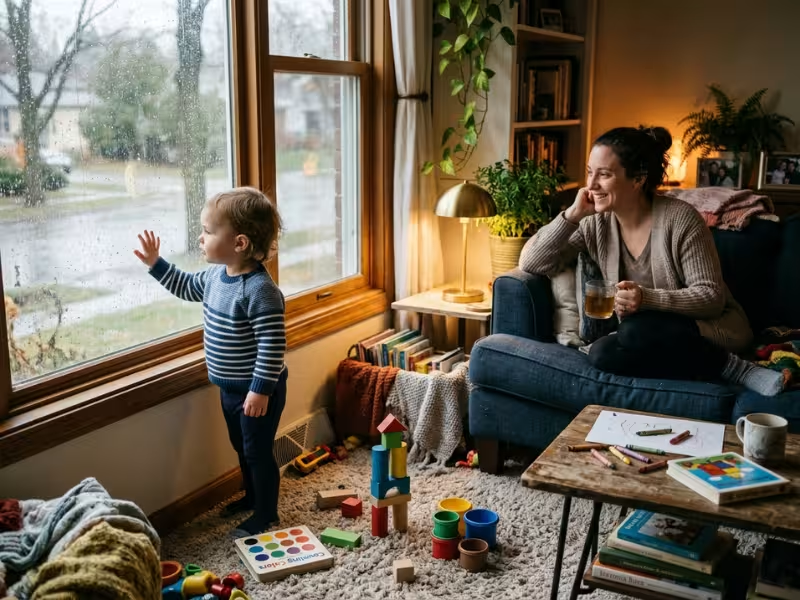
Rain taps the window. Your toddler has pulled every toy off the shelf and still whines at the door. You set out crayons. They last two minutes.
Most toddlers can play just fine. The real problem is a mismatch. Many indoor activities feel too hard, too slow, or too fussy for this age.
I help parents find activities that actually work. The secret isn’t more options. It’s better matches.
You don’t need 20 ideas. You need the right three or four that fit your child’s age, energy level, and how much setup you can handle today.
Why Some Indoor Activities Work and Others Fail
When a parent tells me an activity “didn’t work,” I ask what happened in the first two minutes. The answer usually points to one of six problems.
It’s too hard. A 15-month-old can’t fit pegs into tiny holes. Frustration builds fast, and the toy flies across the room.
It takes too long to set up. Spend 20 minutes on a sensory bin, and your toddler has already found the dog’s water bowl.
It involves too much waiting. Taking turns, letting paint dry, or watching you demonstrate drains patience fast. Toddlers want busy hands right away.
It has too many pieces. Fifty pom-poms look fun to you. To a toddler, they look like something to dump. Small parts also pose a choking risk for kids who still mouth objects.
It keeps them too still. A restless 2-year-old won’t sit for a puzzle. The body needs to move first.
It misses their stage. An 18-month-old loves to fill and dump. A 3-year-old craves pretend play and a small challenge. Swap their activities, and you lose both kids.
None of these failures comes from a “difficult” child. They come from a gap between the activity and the moment.
So before I suggest anything, I run three quick checks.
Age shows what your child can handle. It sets the rules for size, safety, and how many steps an activity can have.
Energy level shows what your child needs right now. A wound-up toddler needs movement. A cranky one needs calm. Same child, different hour, different activity.
Parent effort shows what you can realistically give. Be honest with yourself. On a tired afternoon, a two-minute setup beats a perfect plan you never start.
Run these three checks, and even simple activities hold attention longer.
How to Choose the Right Indoor Activity
Those three checks only help if you know what to look for. Here’s how I use each one when a parent asks me what to try today.
Start With Your Child’s Age
Age sets the limits. It tells you how many steps an activity can have, how long it might hold attention, and which materials need to stay out of reach.
12 to 18 months: one action, repeated. Kids this age love to drop, dump, pull, bang, and push. Expect 2 to 5 minutes per activity. They still put everything in their mouths, so skip anything small enough to fit through a toilet paper tube.
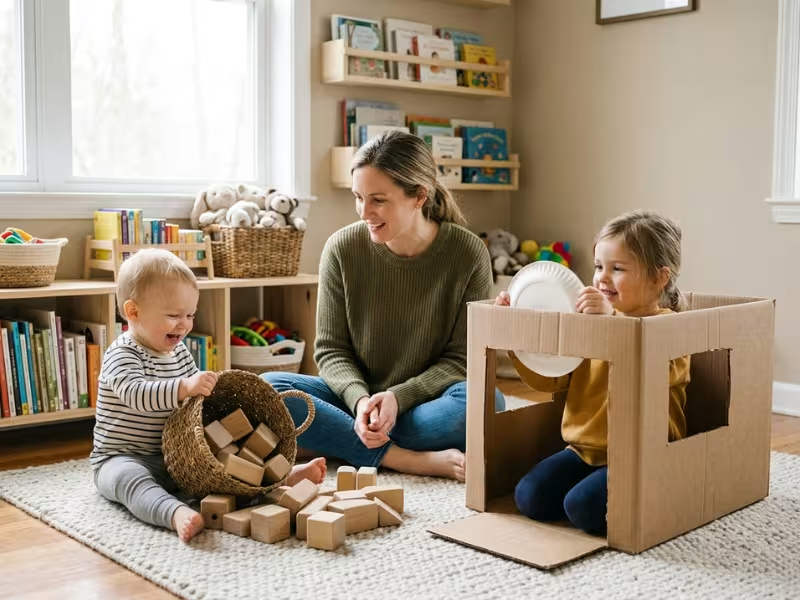
Good fits include a basket of big blocks to dump out, or a tissue box packed with scarves to pull free.
18 to 24 months: two-step play. Now they can fill and then dump, or pick up and then place. Attention stretches to 5 to 10 minutes on a good day. Mouthing slows but doesn’t stop. They love to copy you, and many start matching simple colors.
Try pouring water between cups, sticking notes on the wall, or stacking cups.
2 to 3 years: short sequences and pretend play. They can follow two- or three-step directions, sort by color or size, and turn a box into a bus. Expect 10 to 15 minutes, and sometimes longer when the idea comes from them. They can handle small parts while you sit close by, but stay alert.
Muffin tin sorting, tape roads for toy cars, and simple obstacle courses all work well here.
If your child falls between stages, pick the younger option. An easy win builds confidence. A hard activity only builds frustration.
Read the Mood Before You Pick
Age tells you what your child can do. Mood tells you what they need in the next 20 minutes. I watch for four states.
Restless and bouncing off furniture. Start with movement. Set up a cushion path, play a dance song, or lay tape lines to jump between. Hold the puzzle until the body settles.
Cranky or overstimulated. Cut the input. Dim the lights, put most toys away, and offer one calm task. Water painting, a book in a quiet corner, or plain play dough with no tools all help. Skip anything loud, bright, or new.
Calm but clingy. Stay close and play side by side. Read together, sort socks together, or let them “help” you wipe the table. Pushing independence here usually backfires.
Ready to play alone. Protect this window. Offer something open-ended, like a box, stacking cups, or a bin of scarves, and then step back. Don’t narrate or correct. Quiet focus often lasts longer than you expect.
Toddler moods shift fast. Keep one idea from each group in your head so you can switch without scrambling.
Be Honest About Your Setup Time
The best activity is the one you’ll actually set up. I sort activities into three effort levels and ask parents which one they can manage today.
2-minute setup: grab and go. Sticky notes, painter’s tape, a laundry basket with soft balls, or a cardboard box. These save tired afternoons and work calls. Keep the supplies together in one bin so you never have to hunt for them.
10-minute setup: a little prep for longer play. Pouring stations, muffin tin sorting, and short obstacle courses fit here. Set them up during nap or the night before. Then bring them out during the hardest hour of your day, which for many families is late afternoon.
Messy but high payoff: worth it on the right day. Edible paint, play dough, and water play give the richest sensory experience. They often hold attention the longest, too. But they cost you cleanup time. Save them for days when you still have energy. Plan the cleanup before you start: towel on the floor, sleeves rolled up, bath right after.
Here’s the rule I give every parent: match the effort to your energy, not your guilt. A two-minute activity you do today beats a perfect project that never happens.
Five Low-Prep Activities That Actually Hold Attention
Low-prep activities matter most on the days you have the least to give. Each one below starts in under 10 minutes, and most use things already in your kitchen drawer.
I chose these five because they stretch across the whole 1-to-3 range with small tweaks. For each, you’ll see who it suits, what it builds, and where it tends to fall apart.
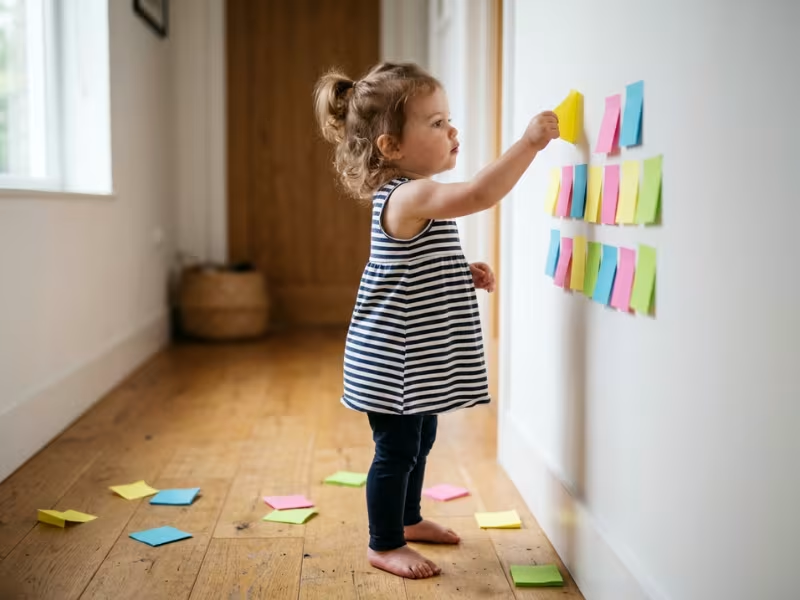
Sticky Notes on the Wall
Press 10 to 15 sticky notes onto a wall or window at your child’s eye level. Then let them peel. That’s the whole activity, and toddlers love it.
- Best age: 15 months to 3 years
- Setup: 2 minutes
- Helps with: Pincer grasp, finger strength, and hand-eye coordination
- Make it last longer: Give 2-year-olds a job, like “Move all the yellow ones to the door.” For older kids, draw a simple shape on each note and call out which one to find.
- What can go wrong: Young toddlers chew paper, so stay close. Skip wallpaper and fresh paint, since both can peel off with the notes.
Muffin Tin Sorting
Set out a muffin tin and a bowl of large objects. Chunky building blocks, plastic jar lids, and big bath toys all work. For older toddlers, tape a colored paper circle inside each cup.
- Best age: 18 months for filling and dumping, and 2 to 3 years for color sorting
- Setup: 5 to 10 minutes
- Helps with: Early sorting, color recognition, and careful hand control
- Make it last longer: Hand a 2½-year-old kitchen tongs or a big spoon to move each item. The extra challenge often doubles play time.
- What can go wrong: Small items creep in. Run the toilet paper tube test on every piece. And if your 18-month-old dumps the whole tin, let it go. At that age, dumping is the point.
Tape Lines on the Floor
Grab painter’s tape and lay out a straight line to walk, a zigzag to follow, or a few squares to hop between. Add a two-lane road, and toy cars instantly have somewhere to go.
- Best age: 18 months for walking lines, and 2 years and up for jumping
- Setup: 2 to 5 minutes
- Helps with: Balance, gross motor skills, and following simple directions
- Make it last longer: Change the shape after nap. Call out new moves, like “Tiptoe on the line,” or “Walk like a bear.”
- What can go wrong: Tape can leave residue on rugs, so stick to hard floors. Socks slip on smooth surfaces, so go barefoot. If your toddler peels up the tape, count it as a bonus fine motor task.
Cardboard Box Play
A big box can do more than most toys on your shelf. One-year-olds crawl in and out. Three-year-olds turn it into a rocket, a bus, or a house.
- Best age: 12 months to 3 years
- Setup: 1 to 5 minutes
- Helps with: Pretend play, spatial awareness, and climbing skills
- Make it last longer: Cut a door and a window. Toss in a blanket and a flashlight. Hand over chunky crayons so they can decorate from the inside. Open both ends to make a tunnel.
- What can go wrong: Pull out every staple and strip of packing tape first. Boxes also collapse when kids climb on top, so set it on carpet and keep it away from furniture edges.
Simple Pouring Station
Pour an inch of water into a shallow bin. Add two plastic cups and a small pitcher. Set it all on a towel, on the high chair tray, or right in an empty bathtub.
- Best age: 18 months to 3 years
- Setup: 5 minutes
- Helps with: Hand control, cause and effect, and early measuring
- Make it last longer: Add a funnel, a sponge, a ladle, or a few ice cubes. A drop of food coloring makes the water feel brand new.
- What can go wrong: Water ends up everywhere. Keep it shallow, keep a second towel nearby, and never leave a toddler alone with water, even for a moment.
Keep the supplies for all five in one bin by the door. When the next hard afternoon hits, you won’t need a plan. You’ll just open the bin.
The Best Indoor Activities for Burning Energy
A toddler with nowhere to run will find somewhere to run. Usually it’s the couch, the stairs, or a lap around the kitchen at full speed. When families need a larger space for movement than home can offer, structured indoor playground equipment can give toddlers a safer way to climb, crawl, and stay active year-round.
At home, active play still solves the problem, but it isn’t about letting kids go wild. The goal is movement with boundaries. Before any game below, I give parents three ground rules:
- Pick one play zone. Clear a rug or hallway. Move coffee tables, cords, and anything with sharp corners.
- Keep rounds short. Play for 3 to 5 minutes, take a quick break, and then go again. Toddlers tire faster than they show.
- Slow down before the crash. Louder voices, wild giggles, and clumsy falls mean it’s time to wind down, not speed up.
With those rules in place, these five activities burn real energy without wrecking the house or the afternoon.
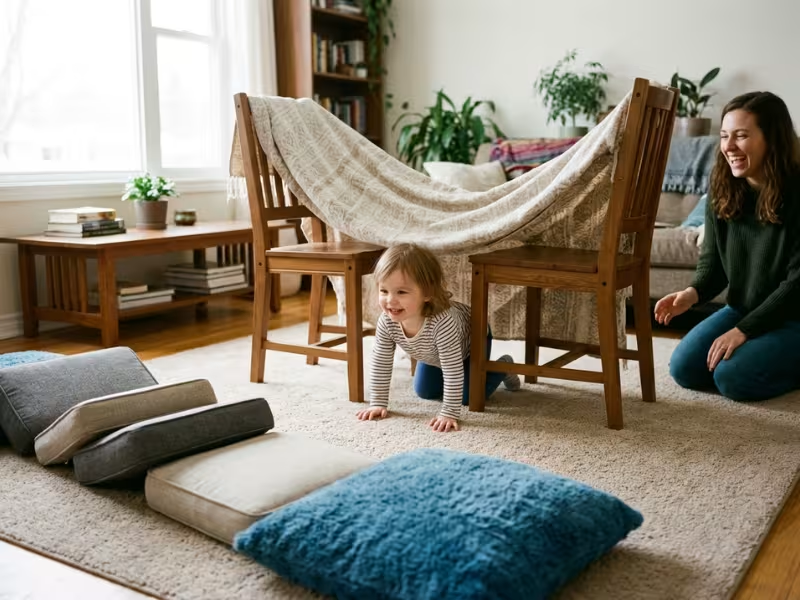
Indoor Obstacle Course
Line up couch cushions to climb over, a blanket over two chairs to crawl under, and a pillow to jump onto. Three or four stations are plenty.
- Best age: 18 months to 3 years. One-year-olds can crawl over a single row of cushions.
- Setup: 5 to 10 minutes
- Helps with: Climbing, crawling, balance, and following a sequence
- Make it last longer: Swap one station each round. Give a mission, like carrying a stuffed bear through the course. Let 3-year-olds change the order.
- What can go wrong: Cushions slide on hard floors, so build on a rug. Keep every station lower than your child’s knees, and keep the course away from tables and windows.
Dance Party and Freeze Dance
Play three upbeat songs and dance together. For older toddlers, pause the music and shout, “Freeze!”
- Best age: 12 months for dancing, and 2 years and up for freeze rules
- Setup: Under 1 minute
- Helps with: Rhythm, coordination, listening, and early self-control
- Make it last longer: Call out silly freezes, like “Freeze like a tree!” Add scarves to wave. Let your child press pause.
- What can go wrong: Spinning leads to dizzy falls. Kids under 2 won’t freeze reliably, and that’s fine. End on a slow song so energy drops instead of spiking.
Balloon or Soft Ball Games
A balloon floats slowly, so toddlers can track it and hit it. Soft balls work well for tossing into a laundry basket or rolling down a hallway.
- Best age: Soft balls from 12 months. Balloons from 2 years, with an adult in charge.
- Setup: 2 minutes
- Helps with: Hand-eye coordination, reaching, throwing, and tracking
- Make it last longer: Count how many taps keep the balloon in the air. Move the basket back a step. Roll a ball to knock down a tower of plastic cups.
- What can go wrong: Popped or uninflated latex balloons pose a serious choking risk. Inflate the balloon yourself, never let your child mouth it, and pick up every scrap right away if it pops. For kids under 2, stick with soft balls.
Animal Walks
Call out an animal, and move like it together. Bear crawl, frog jump, crab walk, and penguin waddle are all great picks.
- Best age: 18 months to 3 years. Younger kids can copy easy moves, like a bunny hop.
- Setup: None
- Helps with: Arm, leg, and core strength, plus coordination and imitation
- Make it last longer: Race from wall to wall. Add animal sounds. Let 2½-year-olds pick from picture cards.
- What can go wrong: Crab walks and frog jumps tire small muscles fast. Use two or three animals per round, and clear toys from the path first.
Tape Jump Path
This takes simple tape lines up a notch. Lay painter’s tape squares a short hop apart, leading from the living room to the hallway. Add a long line to leap over or a big “lily pad” to land on.
- Best age: 2 to 3 years. Kids around 18 months can step from square to square.
- Setup: 5 minutes
- Helps with: Jumping, landing, balance, and motor planning
- Make it last longer: Change the spacing after nap. Call out moves like “Two-foot jump!” Put a favorite toy at the finish.
- What can go wrong: Squares set too far apart cause falls, so start about 12 inches apart. Use bare feet on hard floors, never socks.
End the Round Before the Meltdown
How active play ends matters as much as the game itself. Energy that climbs too high usually crashes into tears.
Give a two-minute warning. Then run a slow-down: one quiet song, a “sleepy bear” crawl, or five big breaths to blow out pretend candles. After that, move straight into a calm activity, like a book or water painting.
Stop while your child still wants more. You aren’t cutting the fun short. You’re making the next round easy to start.
Quiet Activities That Actually Calm Toddlers Down
Calm play matters most at four moments: before nap, before dinner, when you need 10 minutes, and when your toddler is already overloaded.
Not every quiet activity calms, though. A puzzle that’s too hard looks peaceful for 90 seconds, then ends with a piece flying across the room. The activities that truly settle toddlers share three traits. They use slow, repeated hand movements, offer few choices, and put no pressure on the child to finish. These five pass that test.

Book Nook Read-Alouds
Pile a few cushions in a corner and set five books in a low basket. Then sit down and read together.
- Best age: 12 months to 3 years
- Setup: 2 minutes
- Helps with: Language, listening, and winding down before sleep
- Make it last longer: Rotate books weekly. Let your child turn pages and point to pictures.
- What can go wrong: Ten books on display means ten books dumped. Keep the choice small.
Felt Board Stories
Glue felt onto a cookie sheet and cut out simple shapes, like a sun, a tree, a cat, and a house.
- Best age: 2 to 3 years, or 18 months with extra-large pieces
- Setup: 10 minutes the first time, then 1 minute
- Helps with: Vocabulary, storytelling, and fine motor control
- Make it last longer: Tell a short story while your child places each piece. Then switch roles.
- What can go wrong: Felt ends up in mouths. Make every piece too big to fit through a toilet paper tube.
Puzzles and Shape Sorters
Set out one puzzle or sorter on a clear table or floor mat. Keep everything else out of sight.
- Best age: Three-shape sorters at 15 months, knob puzzles at 18 to 24 months, and 4- to 6-piece puzzles near age 3
- Setup: 1 minute
- Helps with: Problem solving and hand control
- Make it last longer: Offer one puzzle at a time. Hide pieces under a cloth for your child to find first.
- What can go wrong: This activity often looks calm but isn’t. When your child is tired, choose one level easier than usual.
Water Painting
Give your child a cup of water and a chunky brush, then let them paint on cardboard. Each mark fades as it dries.
- Best age: 18 months to 3 years
- Setup: 2 minutes
- Helps with: Grip, focus, and gentle sensory input
- Make it last longer: Draw chalk shapes first, then let your child “erase” them with water.
- What can go wrong: Cups tip. Pour in just an inch of water, and use a heavy mug.
Sticker or Crayon Time
Tape a large sheet of paper to the table and set out a few chunky crayons or a sticker sheet.
- Best age: Chunky crayons from 15 months, and stickers from 2 years
- Setup: 1 minute
- Helps with: Pincer grasp and early drawing
- Make it last longer: Keep the paper taped down so it stays put. Peel sticker edges ahead of time.
- What can go wrong: Crayons wander onto walls, and young toddlers chew stickers. Sit close.
Use the same quiet spot each day, and dim the lights. If calm play falls apart, the activity is usually too hard or offers too many choices. Cut both, and try again.
Messy Play That Is Actually Worth the Cleanup
Some messy play earns every minute of scrubbing. Some doesn’t. Rice bins, glitter, and shaving cream often cost 30 minutes of cleanup for 5 minutes of fun.
I use one simple test: will the play last at least three times longer than the cleanup? If not, skip it. These three activities usually pass the test, as long as you set them up right.
Edible Paint for Young Toddlers
Mix plain yogurt with a drop of food coloring, or use mashed berries or sweet potato. Your child can paint, smear, and taste without any worry.
- Best age: 12 to 18 months, while everything still goes in the mouth
- Setup: 5 minutes. Strip your toddler down to a diaper and let them paint on the high chair tray. In a small space, tape paper inside a rimmed baking sheet. The edges hold the mess, and the whole thing slides into the sink.
- Helps with: Sensory exploration, hand strength, and early cause and effect
- Make it last longer: Add a second color halfway through. Hand over a spoon or a clean sponge to drag through the paint.
- What can go wrong: A hungry or tired child turns the paint into lunch, and lunch turns into a food fight. Avoid raw flour paints at this age, since uncooked flour can carry germs. Head straight to the bath when play ends.
Play Dough
Play dough gives toddlers a long stretch of squeezing, rolling, and poking. Many kids stay with it for 15 minutes or more.
- Best age: 18 months to 3 years
- Setup: 2 minutes. Work on a silicone mat or a large cutting board. In a small space, keep play at the high chair or a booster seat.
- Helps with: Hand strength, squeezing and rolling, and early tool use
- Make it last longer: Offer one color at a time so nothing turns brown. Add one new tool per session, like a rolling pin or a cookie cutter. Store each batch in a zip bag so it stays soft for weeks.
- What can go wrong: Some toddlers eat it by the handful. Homemade salt dough contains a lot of salt, so stay close and wait until mouthing slows. Let stray crumbs dry, and then sweep them up.
Contact Paper Art
Tape a sheet of contact paper to a window, sticky side out. Hand over torn tissue paper or fabric scraps, and let your child press them on.
- Best age: 2 to 3 years
- Setup: 5 minutes. Tear the pieces ahead of time and serve them in a shoebox lid. Nothing wet, nothing to wipe. In a small space, use a cabinet door or the side of the fridge.
- Helps with: Pincer grasp, color and texture exploration, and simple design choices
- Make it last longer: Add a new texture halfway through, like ribbon or felt scraps. When your child finishes, fold the sheet in half to seal the art as a keepsake.
- What can go wrong: Kids who still mouth small bits will try to eat the tissue. Sticky edges also grab hair and fold over fast, so sit nearby the whole time.
Plan the cleanup before you open anything. Put a towel down, roll up sleeves, and keep wipes within reach. And save messy play for days when you still have energy left. On a rough afternoon, a dry activity wins.
Everyday Tasks That Work as Play
Some days you have nothing left for a sensory bin. That’s okay. Your toddler doesn’t need one.
Toddlers love real work. They watch you wipe, fold, and rinse all day, and they want in. A real job gives them practice with grip, sorting, balance, and new words. It also gives them something they crave at this age: the feeling of being useful. Real chores aren’t a backup plan. They count as some of the best play you can offer.
Here’s how I set up five easy ones.
Matching socks. Dump clean socks on the floor and ask, “Can you find the other blue one?” Sorting by color and pattern builds early matching skills. Start with three pairs for 18-month-olds. Two-year-olds can tackle the whole basket.
Wiping the table. Hand your child a damp cloth and a small spray bottle of plain water. Squeezing the trigger strengthens little hands, and wiping uses big arm movements. Point out “spots” they missed, and they’ll keep going.
Washing produce. Set a step stool at the sink with a bowl of potatoes or apples in shallow water. Let your child scrub with a soft brush. Keep knives out of reach, and stay right beside the stool.
Loading laundry. Toddlers love pushing clothes into a front-loading washer. Hand over one item at a time and count each one out loud. Expect to hear “More!” fast.
Basket toss cleanup. Set a laundry basket a few steps away and turn toy pickup into a game: “Can you throw the bear in?” Move the basket back each round. Kids under 2 can simply drop toys in.
Describe what your child does, and skip the corrections. A lumpy sock pile still counts. When toddlers feel like real helpers, they often stay busy longer than they do with most toys.

Common Reasons Toddlers Reject an Activity
Every parent hits this wall. You set something up, and your toddler walks away in seconds. These are the four complaints I hear most, along with the fix I give for each one.
“My Toddler Loses Interest in Two Minutes”
Two minutes is normal for a 1-year-old. So don’t fight the clock. Plan around it.
When your child walks off, leave the activity out for 10 more minutes. Many toddlers circle back on their own.
Each time they return, add one small twist. Hand over a spoon. Hide a toy in the bin. Swap the cup for a funnel. A tiny change can easily double play time.
“My House Is Too Small”
You don’t need a playroom. You need one cleared spot.
A 4-by-6-foot rug fits most activities on this list. Run tape lines down a hallway. Turn an empty bathtub into a pouring station. Use the high chair tray for anything messy.
Store all supplies in one bin under the couch or bed. When play ends, everything goes back in seconds, and your living room stays yours.
“I Don’t Have Time to Set This Up”
Prep once, and use it all week. On Sunday night, fill three shoeboxes:
- Move: Painter’s tape and soft balls
- Pour: Plastic cups, a funnel, and a sponge
- Quiet: Chunky crayons, stickers, and paper
When a hard moment hits, grab the box that fits the mood. Setup takes under a minute.
Tape a short list of zero-prep ideas to the fridge, too: dance party, animal walks, and matching socks.
“My Child Refuses Everything I Offer”
Too many choices often cause this. Put most toys out of sight, and keep just six to eight on the shelf. Rotate them each week.
Next, stop presenting. Sit nearby and start playing yourself. Stack cups or roll dough without inviting your child. Curiosity usually wins within a few minutes.
Check the basics, too. A hungry, tired, or sick toddler will refuse almost anything. Offer a snack or some rest first.
If the refusals last for days, go one step easier. A win your child can finish beats a challenge they keep avoiding.
A Quick Age-and-Effort Table
When parents ask me what to try today, I start with two questions: how old is your child, and how much energy do you have left? This table answers both in one place.
Find your child’s age row. Then read across to see which activities fit, what to skip, how long play usually lasts, and how much you’ll need to put in.
If your child falls between two rows, start with the younger one. An easy win beats a hard flop every time.
|
Age Range |
Best Activity Types |
Avoid |
Ideal Activity Length |
Parent Effort |
|---|---|---|---|---|
|
12–18 months |
One-action play: dumping big blocks, pulling scarves from a tissue box, rolling soft balls, crawling through a box, edible paint, board books |
Small parts that fit through a toilet paper tube, balloons, play dough, multi-step tasks, anything that involves waiting |
2–5 minutes |
High: Setup is quick, but you need to stay within arm’s reach the whole time |
|
18–24 months |
Two-step play: pouring water between cups, sticky notes on the wall, stacking cups, knob puzzles, walking tape lines, dance parties, matching socks |
Freeze-dance rules, tiny puzzle pieces, rice or glitter bins, activities with one “right” way to finish |
5–10 minutes |
Medium: 2 to 10 minutes of setup, plus close supervision with water and anything small |
|
2–3 years |
Short sequences and pretend play: muffin tin sorting, obstacle courses, tape jump paths, box play, felt board stories, play dough, contact paper art |
Long demos before play starts, crafts with more than three steps, activities that feel too babyish, balloon play without an adult |
10–15 minutes, often longer when the idea comes from them |
Medium to low: Richer play may take more setup, but many kids can play alone for short stretches while you stay nearby |
From your row, pick three activities: one to move, one to pour or sort, and one to calm. That gives you a full afternoon plan without extra prep.
Common Parent Questions
Here are quick answers to the questions parents ask me most.
What indoor activities are safe for a 1-year-old?
Pick activities with big pieces and simple actions. Dumping blocks, pulling scarves from a tissue box, rolling soft balls, crawling through a box, and painting with yogurt all work well.
Test every item with a toilet paper tube. If it fits through, keep it away. Skip balloons and play dough for now.
How long should a toddler activity last?
Expect these ranges:
- 12 to 18 months: 2 to 5 minutes
- 18 to 24 months: 5 to 10 minutes
- Near age 3: 10 to 15 minutes
Short play is normal. Leave the activity out, and your child may come back to it.
How do I keep a toddler busy while I work from home?
Prep before the workday starts. Fill a few shoeboxes with low-mess supplies, such as stickers, stacking cups, or sticky notes. Save the best box for your most important call.
Set up near your desk so your child can see you. Skip anything with water.
What are good indoor activities for a 2-year-old with lots of energy?
Try a cushion obstacle course, animal walks, freeze dance, or a tape jump path. Clear one safe play zone first, and keep rounds to 3 to 5 minutes.
Finish with a slow song or a book. That lets energy drop gently instead of crashing into tears.
How can I do messy activities without ruining my floors?
Contain the mess before it starts. Use a high chair tray, a rimmed baking sheet, or an empty bathtub. Lay an old shower curtain or towel under the play area.
Choose washable or edible materials. When play ends, head straight to the bath.
What should I do when my toddler refuses every activity?
Check hunger, sleep, and health first. Then cut the choices. Keep six to eight toys out, and rotate the rest each week.
Stop presenting activities. Sit nearby and start playing yourself. Curiosity often pulls your child in within minutes. If the refusals continue, make the activity one step easier.
Pick Three Activities and Let the Rest Wait
Your toddler doesn’t need a packed schedule or a shelf full of new ideas. They need a few activities that fit their age, their mood, and the energy you have left.
Choosing well beats preparing more. A two-minute activity that fits the moment will hold attention longer than a big project that misses it.
So keep tonight simple. Choose one low-prep activity, one active activity, and one calming activity. Put the supplies for each in a separate box where you can grab them fast.
When tomorrow gets hard, read your child’s mood, open the matching box, and start playing.