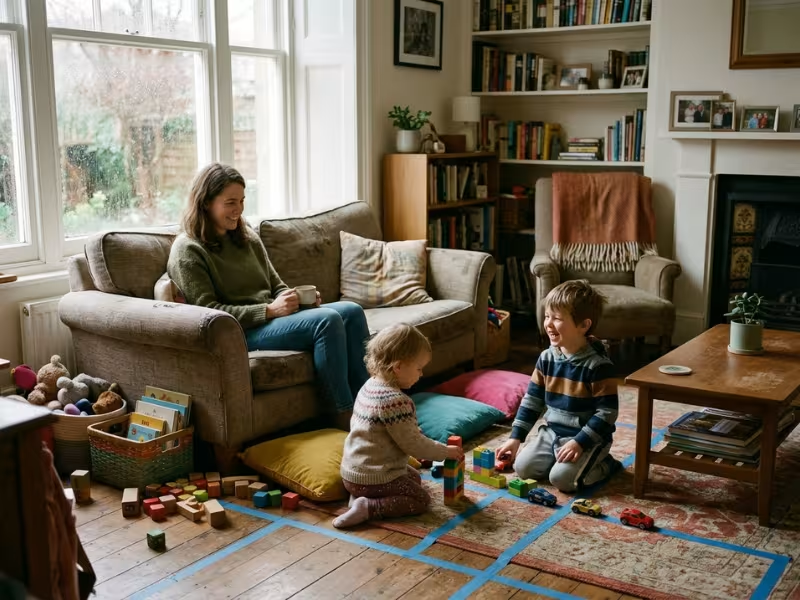
The rain starts at 9 a.m. By 9:15, your toddler is climbing the couch, and your preschooler is chasing the dog down the hall.
You don’t need another long list of indoor activities. You need indoor playground games that fit your home and your kids. I have helped many families turn messy rainy days into active, happy ones.
This guide helps you choose by four things: your child’s age, your space, your setup time, and whether your kids need to burn energy or settle down.
Simple games at home go a long way. Well-planned indoor playground equipment supports the same goals in schools, play centers, and family spaces.
How to Choose the Right Indoor Game
Most rainy-day plans fail because the game doesn’t fit the moment. Run through these four quick checks before you start. They take about 30 seconds.
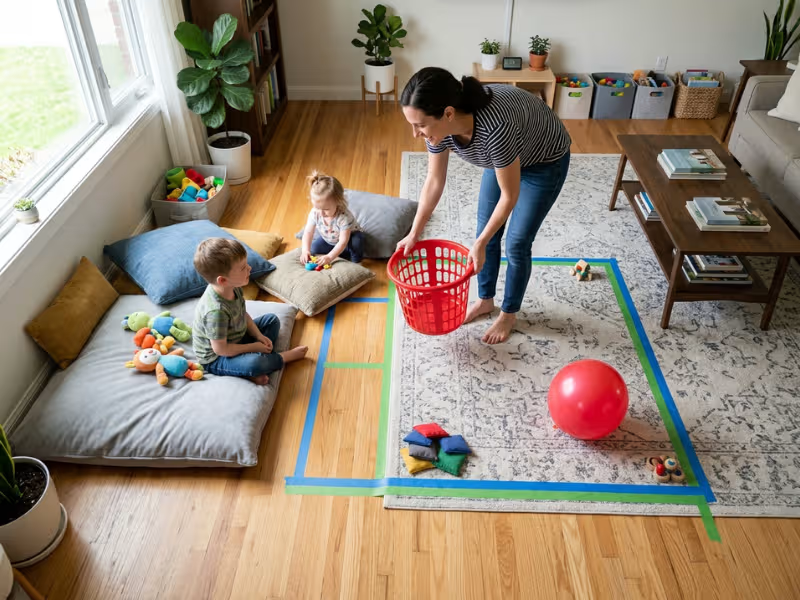
Start With Age and Attention Span
Toddlers (ages 1 to 3) lose interest fast. I plan 3- to 5-minute rounds with one-step rules, like “freeze when the music stops.”
Preschoolers (ages 4 to 5) can handle 10 to 15 minutes and two or three rules. They love a clear goal, such as beating their own time.
My rule: if you need more than 30 seconds to explain a game, it’s too complicated for this age group.
Match the Game to Your Space
Your floor plan shapes the game more than most parents expect.
- Living room: Best for obstacle courses and freeze dance. Push the coffee table against the wall first.
- Hallway: Perfect for straight-line games like tape balance beams, beanbag bowling, or animal races.
- Bedroom: Good for calm games like scavenger hunts. Keep jumping off the bed off-limits.
Try a quick test. Ask your child to spin with arms out. If they hit something, skip running games in that room.
Decide on Your Energy Goal
Ask one question: do my kids need to burn energy or settle down?
Wild kids before lunch need dancing, crawling, or chasing balloons. Cranky kids before nap need slower games, like color hunts or tape mazes. A high-energy game right before nap often ends in tears.
Be Honest About Setup Time
- Zero prep: Freeze dance, Simon Says, animal walks. You start in under a minute.
- Low prep: Tape lines, balloon games, sock toss. Five minutes or less.
- Some prep: Obstacle courses or clue hunts. Give yourself 15 minutes, or build them with your kids.
On tired days, go zero prep. A simple game you actually start beats a great game you never set up.
Best Indoor Games for Burning Energy
When kids bounce off the walls, that energy needs somewhere to go. I reach for these four games first, because they get bodies moving hard without turning your living room into a crash zone.
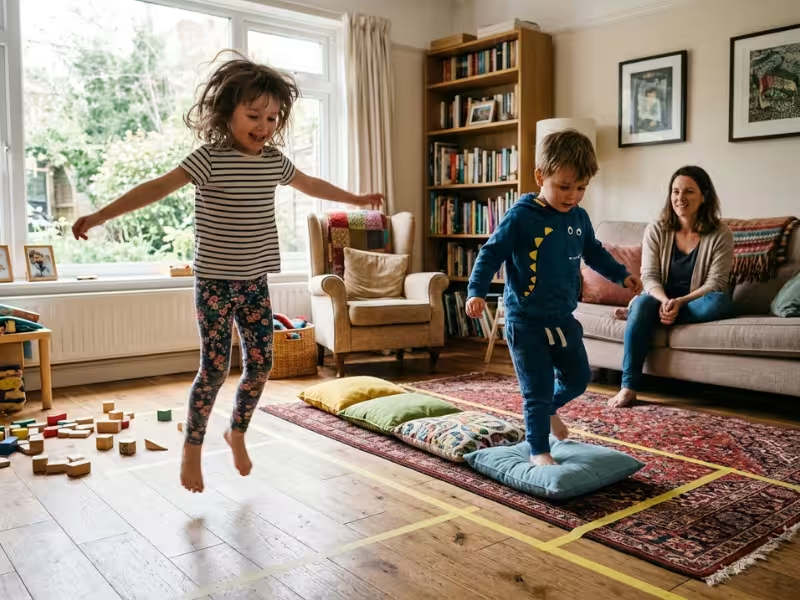
Freeze Dance and Musical Statues
The stop-and-go pattern tires kids out faster than steady play. It also builds self-control.
- Best age: 18 months and up
- Space needed: A clear patch about 6 by 6 feet
Keep dancers barefoot or in grip socks. Regular socks on hardwood turn every freeze into a slide. For toddlers, stop the music every 10 to 20 seconds so the freeze stays exciting.
Try this: Animal Freeze. Call out an animal before each song. Kids dance like that animal, then freeze in its pose. A frozen flamingo on one leg is harder than it looks.
Indoor Obstacle Course
An obstacle course works almost every big motor skill at once: crawling, stepping, balancing, and jumping.
- Best age: 2 and up (3 to 4 stations for toddlers, 6 to 8 for preschoolers)
- Space needed: A living room, or one room plus a hallway
Keep every obstacle low. Nothing a child stands on should sit higher than their knee. Lay cushions flat, and put a rug under any jumping spot. Swap one station every three laps, and let your preschooler pick the change.
Try this: Lava Floor Loop. Crawl through a blanket tunnel, hop across four cushion “stones,” walk a tape line, and toss a ball into a laundry basket. Time each lap and chase a personal best.
Balloon Keep-Up and Balloon Volleyball
Balloons float slowly, so little kids have time to track, reach, and swing. Kids stretch and jump a lot, yet almost nothing breaks.
- Best age: 2 and up, with close adult supervision
- Space needed: Any room with open space overhead
Popped latex balloon pieces pose a serious choking risk for children under 8. Inflate balloons yourself, stay in the game, and pick up broken pieces right away. Foil balloons work better for toddlers.
Try this: String-Net Volleyball. Tie yarn between two chair backs at shoulder height. Start with hands, then switch to paper-plate paddles.
Animal Movement Races
Bear crawls, frog jumps, and crab walks look silly, but they build core and arm strength.
- Best age: 2 and up
- Space needed: A clear lane about 10 to 15 feet long
Mark the finish with tape at least 3 feet before any wall or door. Kids on all fours rarely look ahead.
Try this: Animal Draw Relay. Drop six animal names in a cup. Your child draws one for the trip out and another for the trip back. Join the race yourself. Kids push harder with a parent bear-crawling beside them.
Best Indoor Games for Small Spaces and Apartments
A small home doesn’t mean small fun. Pick games that stay low to the ground, keep noise down, and never send kids racing toward furniture.
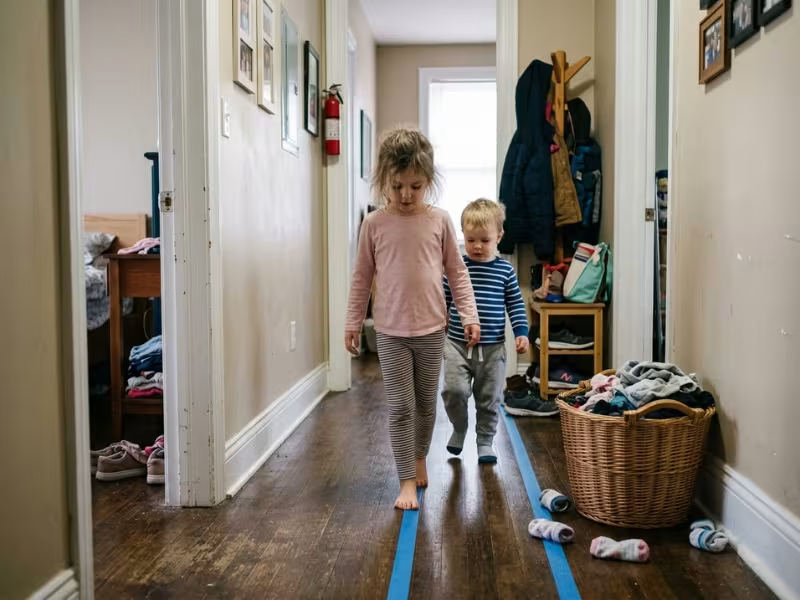
Tape Maze and Tape Balance Line
Painter’s tape turns any bare floor into a quiet game board.
- Best age: 2 and up
- Space needed: A 4-by-6-foot patch of floor or a hallway
Give toddlers one straight “tightrope” line. Preschoolers can handle zigzags and dead ends. Use painter’s tape only, and peel it up the same day to protect your floors.
Try this: Toy Rescue Maze. Place a stuffed animal at the maze center. Your child stays on the lines to rescue it.
Scavenger Hunt
Hunts keep kids moving at a walking pace, which suits apartments with neighbors below.
Toddlers do well with color hunts, like “Find three red things.” Preschoolers enjoy picture clues. Keep lists short: five items for toddlers, eight to ten for preschoolers.
Try this: Rainbow Basket Hunt. Call out one color at a time. Once your child brings back three items, call the next color.
Sock Toss
Rolled socks are soft, quiet, and almost never break anything. Set a laundry basket 2 to 3 feet away for toddlers and 5 to 6 feet for preschoolers. Add two more baskets worth 1, 2, and 3 points to stretch the game.
Quiet Hallway Games
A hallway gives you a natural lane. Try beanbag bowling with six plastic cups, or paper airplane landings on a taped target square. Both keep kids crouching or standing, so you skip the thumping.
Hide-and-Seek for Tight Spaces
Hide the toy, not the child. Hide a stuffed animal and give toddlers “warmer” and “colder” hints. Sardines works for three or more kids: each seeker who finds the hider squeezes into the same spot.
Set rules first. No hiding in closets with latching doors, inside appliances, or near windows.
Small-Space Safety Checklist
- Push coffee tables and chairs against the walls.
- Pad sharp corners with a folded towel or corner guards.
- Clear small toys and loose cords from the floor.
- Lay down a rug or yoga mat to soften falls and footsteps.
- Keep play away from windows, TVs, and anything that can tip.
Best Indoor Games for Mixed Ages
A 2-year-old, a 5-year-old, and a 7-year-old cousin in one room usually means trouble. The little one can’t keep up, the big one gets bored, and you referee every round. The fix isn’t a different game. It’s a smarter setup.

Give Each Age Its Own Rules
Balloons already level the field. Toddlers can catch the balloon or let it bounce once. Older kids must use only elbows or a paddle. Everyone chases one team count, so nobody loses to a faster sibling.
Hunts work the same way. Send everyone out together with separate lists: yellow things for your toddler, “B” words for your preschooler, and short riddles for your 7-year-old.
Build a Two-Lane Obstacle Course
Mark an easy lane and a hard lane with two tape colors.
- Green lane: Step over a pool noodle. Crawl under a table.
- Blue lane: Jump the noodle with feet together. Crawl under the table backward.
Let anyone switch lanes anytime. Preschoolers often try the hard route once they feel brave.
Turn Older Kids Into Helpers
Give older kids a job instead of a rival. A 6-year-old can time laps, run the music, or hide scavenger items. Pair each with a younger buddy and count team scores.
Set three ground rules: take turns, help your buddy, and no rule changes mid-game. Then check in every 10 minutes, not every minute.
The same idea applies beyond the living room. When children of different ages share a play area, layout matters as much as the activity. That’s why many schools and play centers choose custom playground equipment with zones for different skill levels.
The Indoor Games Most Parents Can Skip
Not every popular game belongs indoors. I steer families away from these four types.
Games that take forever to set up. Elaborate forts and craft-heavy stations sound fun, but your toddler loses interest before you finish. Save them for a planned weekend.
Anything that involves sprinting. A running child needs several feet to stop, and walls don’t give them that room. Keep the race and lose the speed with bear crawls or tiptoe races.
Team games with too many rules. Capture the flag and point-based games confuse kids under 6. Stick to one-rule games.
Loud elimination games. Musical chairs means scraping chairs, thumping bodies, and an upset child every round. If you share walls or floors, choose games that keep everyone in and bodies low.
A Simple Rainy-Day Rotation That Actually Works
Most parents don’t run out of games. They run out of steam because one game drags on. Short rotations switch games before boredom hits and balance energy through the day.
Option 1: The 40-Minute Loop
- 10 minutes, high-energy: Freeze dance or animal races.
- 10 minutes, quiet focus: A tape maze or sock toss.
- 10 minutes, challenge: A color hunt or timed obstacle lap.
- 10 minutes, reset: Water, a snack, and calm couch time.
Two loops usually carry you from breakfast to lunch. Set a kitchen timer where kids can see it. They accept a ringing timer far more easily than “one more minute.”
Option 2: The Three-Game Mix
Pick one movement game, one small-space game, and one independent game, such as an obstacle course, a tape line, and a basket of blocks.
Switch when kids wander off, bicker, or get extra silly. The independent game buys you 10 to 15 minutes to make lunch. Lead with movement in the morning, and save quiet games for the hour before nap.
Quick Comparison Table: Which Game Fits Your Situation?
Start with the column that matters most today: noise, prep, or space. Then check the age. Pick two or three matches, and your rainy day is covered.
|
Game |
Best Age |
Space Needed |
Noise Level |
Prep Level |
Best For |
|---|---|---|---|---|---|
|
Freeze Dance |
18 months+ |
6 x 6 ft clear patch |
Medium–High |
Zero |
Burning energy fast |
|
Indoor Obstacle Course |
2+ |
Living room or room plus hallway |
Medium |
Some (about 15 min) |
Full-body play on long mornings |
|
Balloon Keep-Up / Volleyball |
2+ (close supervision) |
Open room or hallway |
Low–Medium |
Low |
Coordination and mixed ages |
|
Animal Movement Races |
2+ |
10–15 ft lane |
Medium |
Zero |
Building strength safely |
|
Tape Maze / Balance Line |
2+ |
4 x 6 ft floor or hallway |
Low |
Low |
Apartments and calm focus |
|
Scavenger Hunt |
2+ |
Any home |
Low |
Zero–Some |
Mixed ages and pre-nap time |
|
Sock Toss |
18 months+ |
About 6 ft of floor |
Low |
Zero |
Tiny rooms and youngest players |
|
Hide-and-Seek (Hide the Toy / Sardines) |
2+ (Sardines needs 3+ kids) |
Any home |
Low |
Zero |
Sibling play in small spaces |
|
Beanbag Bowling |
2+ |
Hallway |
Low |
Low |
Quiet play when you share floors |
Common Parent Questions
What are the best indoor games with no prep?
Freeze dance, animal walks, and Simon Says top my list. Hide-the-toy and sock toss come close behind. You can start any of them in under a minute.
What indoor games work in a small apartment?
Tape mazes, color hunts, sock toss, and beanbag bowling all fit in one room or hallway. They stay quiet, and a rug under the play zone softens footsteps even more.
How do I keep toddlers and preschoolers playing longer?
End each round before boredom hits: 3 to 5 minutes for toddlers, 10 to 15 for preschoolers. Then change one small thing and let kids pick the twist.
What indoor games work for different ages together?
Balloon games, split-list scavenger hunts, and two-lane obstacle courses work best. Give older kids a job, like timekeeper or DJ, and you referee far less.
What are safer alternatives to running games indoors?
Bear crawls, crab walks, and tiptoe races keep the thrill at half the speed. Mark finish lines 3 feet before any wall, and use bare feet or grip socks on hard floors.
Your Rainy-Day Game Plan
You don’t need a huge list to get through a rainy day. In my work with families, two or three well-matched games beat a long list every time.
- Check your space before you pick a game.
- Choose your energy goal: burn it off or wind down.
- Fit the rules to your child’s age.
When those three line up, play flows and you referee less. To build on these ideas over time, simple movement zones and freestanding playground equipment make everyday indoor or covered play easier to manage.
Whether play happens in a living room, a classroom, or a dedicated indoor play space, smart space design always makes good games even better. Bookmark this guide now, and the next time rain cancels the park, you can start playing in minutes.