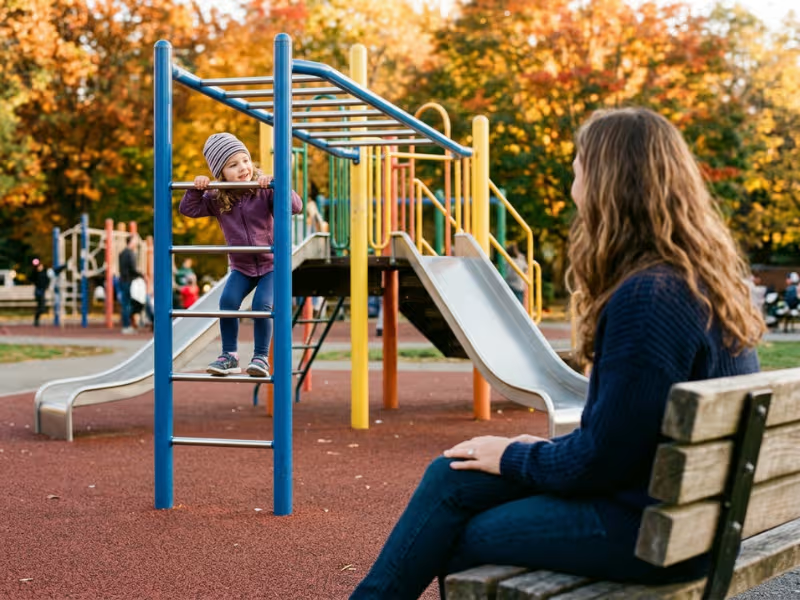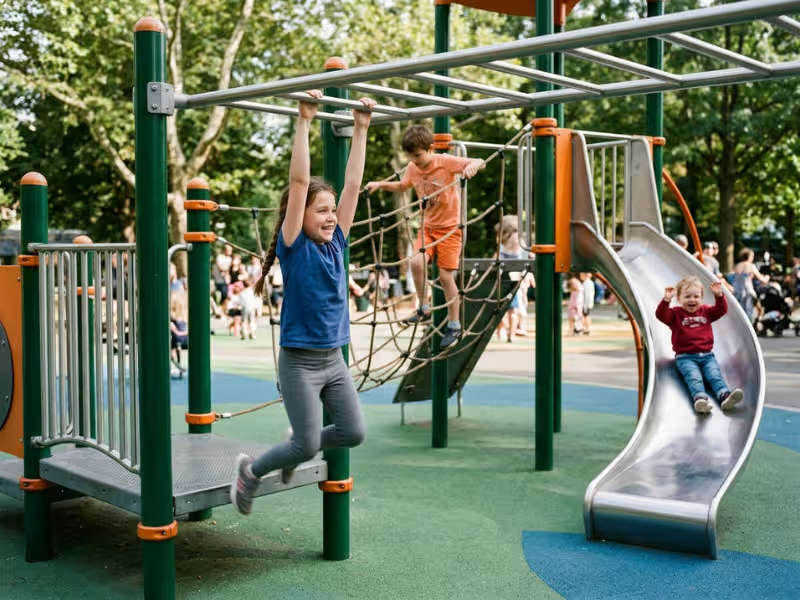
A child swings across the monkey bars, drops down, and races to the swings. Minutes later, she’s a pirate captain shouting orders from the slide.
Many adults call this burning off energy. It’s more than that. Play isn’t the opposite of learning. It’s one way kids learn.
Spend enough time watching kids on playgrounds, and a clear pattern appears. In one recess, they build strength, solve problems, and settle disputes with friends.
Yet many schools and homes now give kids less free play time.
Here’s what playground play really builds, which types matter most, and how you can support it.
Why Playground Play Matters More Than Parents Think
Most parents see the playground as a break. Kids run, yell, and burn off energy, then come home ready for dinner or homework. That view isn’t wrong. It’s just incomplete.
Watch one group of kids for ten minutes, and you’ll see much more going on. A boy sizes up the gap between two platforms and decides whether he can make the jump. Two girls argue over whose turn it is on the tire swing, then agree on a rule. A younger child slips off a climbing net, frowns, and tries again.
In those few minutes, kids use their bodies, their judgment, their social skills, their words, and their emotions all at once. Few other settings ask for that mix. A classroom mostly trains the mind. A sports practice mostly trains the body. The playground trains both, plus everything in between.
The real value doesn’t come from movement alone, though. A treadmill can get a child moving. What sets the playground apart is that kids run the show.
Nobody hands them a plan. They choose the challenge, set the rules, and decide when to quit or push harder. When a game falls apart, they fix it. When a climb feels too high, they find another route.
That’s the shift worth making as a parent. Stop asking, “Did my child get enough exercise?” Start asking, “What did my child figure out today?”
Seen this way, the playground isn’t downtime between lessons. It’s development in motion, and kids lead every step of it.
Free Play Does Something Structured Activities Cannot
Soccer practice, swim lessons, and art classes all have real value. No parent needs to drop them. But they build different skills than free play does, and one can’t stand in for the other.
To see why, it helps to separate three kinds of play that people often lump together.
Free Play, Guided Play, and Structured Activity
Free play: Kids choose what to do, how to do it, and when to stop. A group invents a game of “the floor is lava” on the climbing frame. No adult sets the goal.
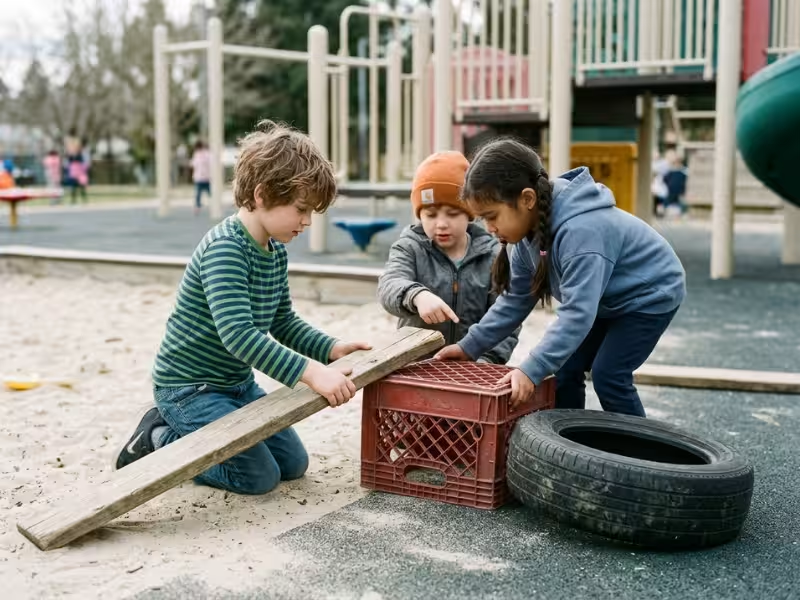
Guided play: An adult shapes the space or nudges the direction, but kids still lead. A teacher drops crates and planks near the sandbox, asks “What could you build?”, and steps back.
Structured activity: An adult runs the show. A coach lines kids up for dribbling drills. The goal, the rules, and the steps all come from the top.
All three have a place. The problem is balance. Many kids today get plenty of structured time and very little free play.
Why Self-Directed Play Builds Different Skills
When kids run their own play, they take on jobs a coach usually handles for them:
- They set goals. “Let’s cross the whole structure without touching the ground.”
- They change the rules. If a game feels boring or unfair, they fix it.
- They handle failure. Nobody explains what went wrong. They work it out and try again.
- They settle conflicts. They argue, bargain, and reach a deal on their own.
A drill can teach a child to kick a ball. It can’t teach them to talk a friend out of quitting, or to invent a fairer rule after a fight.
Here’s a simple habit for parents. When a dispute starts, wait thirty seconds before you step in. Kids often sort it out themselves. That small win teaches them more than any lecture.
Why a Little Risk Is Part of the Lesson
Kids test themselves all the time. They climb one rung higher than last week. They try a new move on the bars. They stand at the edge of a platform and ask, “Can I make this jump?”
That question is the point. Each time, the child weighs height, distance, and their own strength. With practice, they get better at reading what they can handle.
This isn’t recklessness. Manageable risk means a challenge the child can see and choose for themselves, on sound equipment with safe heights and soft surfacing below. A hazard is different. A loose bolt or a hidden gap is a danger the child can’t spot or judge.
Kids who never face small risks don’t become safer. They just get less practice judging danger when it really counts.
What Children Are Really Practicing on the Playground
Every piece of outdoor playground equipment asks a child a different question. The climbing net asks, “How do I get up there?” The swing asks, “How do I keep this going?” The pretend pirate ship asks, “Who are we today?”
When parents or school staff look closely at a playground, it helps to sort play by what kids actually do. Below is what each type of play trains, and what you can watch for.
Climbing: Strength, Planning, and Grit
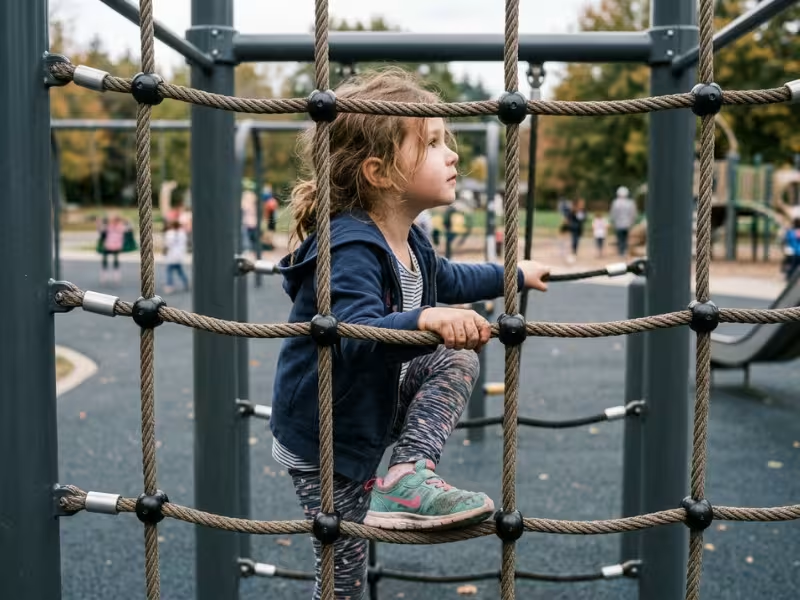
A five-year-old stares up at a rope net. She grabs one strand, lifts a foot, and stops. Her other foot can’t find a hold. She backs down, shifts left, and tries again.
That short climb packs in a lot of work:
- Upper-body strength: Hanging and pulling build the arms, shoulders, and grip kids later use to carry, throw, and hold a pencil steady.
- Bilateral coordination: Each move pairs a right hand with a left foot, or the reverse. Both sides of the body must work as a team.
- Grip planning: Kids learn to choose the next hold before they let go of the last one.
- Spatial judgment: They read gaps, heights, and angles in real 3D space.
Then comes the most valuable part. Climbs fail often. A child slips, rethinks the route, and goes back up. Nobody grades the attempt. That low-stakes loop of try, miss, and adjust builds persistence that carries into harder tasks later.
Watch where your child pauses. Those pauses show planning in action.
Swinging: Rhythm and Body Sense
A swing looks simple, but it’s a rhythm puzzle. On a well-designed freestanding swing set, children get the repeated practice that helps rhythm, body awareness, and force control come together.
To pump, a child stretches their legs forward, tucks them on the way back, and leans the upper body the opposite way. If they kick at the wrong moment, the swing stalls.
Kids learn to keep time with motion. They also hold their core steady while the seat moves beneath them. That trunk control later supports good posture at a desk.
Swinging teaches force control, too. A child learns that a clean, well-timed kick beats a wild, hard one.
The back-and-forth motion also feeds the vestibular system, the inner-ear sense that tracks movement and balance. Many kids find steady swinging calming. Others crave it after a long day of sitting.
Finally, kids build body awareness. They can’t see their feet mid-swing, so they learn to feel where their body is.
Balancing: Focus in Slow Motion
Balance beams look quiet next to the swings, but they ask a lot of a child.
Watch a four-year-old step onto a low beam. Her arms fly out. Her eyes lock on the far end. Each step comes slowly and with care.
Balancing trains core control. The trunk makes tiny corrections with every step to keep the body upright. It also demands focus. A child who glances away often wobbles, so they learn to tune out the noise around them.
Kids plan as they go. They decide where to place each foot before they lift the other.
The best part is self-correction. A child sways, catches herself, and keeps going. No adult needs to say, “Lean left.” Her body figures it out. After a few hundred tries, the skill sticks.
Running, Chasing, and Playground Games
Tag looks like chaos. In fact, it’s one of the busiest skill-builders on the playground.
First, the body. Chasing games deliver short, intense bursts of aerobic activity. Kids sprint, stop, and sprint again. Those bursts often reset attention. Many teachers notice calmer, more focused kids after a good run at recess.
Next, self-control. In freeze tag, a child at full speed has to stop dead when tagged. In “red light, green light,” they must hold still while their body wants to move. That’s impulse control, practiced over and over.
Then come the rules. Kids follow them, bend them, and rewrite them. “The slide is base.” “No tag-backs.” “Little kids get two lives.” Every change needs a group deal.
That’s where social negotiation kicks in. Someone complains the game is unfair. Someone else proposes a fix. The group argues, agrees, or moves on. These small debates teach kids to persuade, compromise, and keep a game alive.
Pretend Play and Loose Parts Play
A plastic crate becomes a boat. Two planks turn into a bridge. Three kids decide the sandbox is a volcano, and someone needs rescuing.
Here, imagination does the heavy lifting.
Pretend play stretches language. Kids assign roles, describe settings, and argue over the plot. “You be the doctor. I’m hurt. No, my leg is hurt, not my arm.” They build stories with a beginning, a problem, and an ending. That narrative thinking later helps with reading and writing.
It also builds perspective-taking. When a child plays the worried parent or the grumpy dragon, they step into someone else’s head for a while.
Loose parts play adds planning and problem-solving. Loose parts are movable, open-ended items like crates, tires, planks, ropes, and tubes. Unlike fixed equipment, they have no single right use. Kids must decide what to build, test it, and fix it when it falls apart.
Picture a group spending twenty minutes on a ramp that keeps tipping over. They try three designs before one holds. Few worksheets train that kind of flexible thinking so naturally.
What Each Type of Play Builds
Here’s a quick view to keep in mind on your next playground visit.
|
Type of play |
Skills it supports |
What adults may notice |
Why it matters |
|---|---|---|---|
|
Climbing |
Upper-body strength, bilateral coordination, grip planning, spatial judgment, persistence |
Pauses before each move, route changes, retries after slips |
Builds strength and the habit of solving problems through trial and error |
|
Swinging |
Rhythm, core stability, force control, vestibular input, body awareness |
Smoother timing, a centered seat, calm at the peak |
Supports posture, balance, and body control used in daily tasks |
|
Balancing |
Core control, focus, movement planning, self-correction |
Arms out, eyes forward, small wobbles caught quickly |
Trains attention and the body’s ability to adjust on its own |
|
Running and chasing games |
Aerobic fitness, attention reset, impulse control, rule-making, negotiation |
Sudden stops, rule debates, new game variations |
Links movement with self-control and group problem-solving |
|
Pretend and loose parts play |
Language, storytelling, planning, perspective-taking, flexible thinking |
Role assignments, shifting storylines, building and rebuilding |
Grows the thinking and social skills kids use in the classroom |
What Research Gets Right, and Where It Still Falls Short
Parents often ask, “Is there real proof behind all this?” The honest answer is yes, but the proof has limits worth knowing.
The broad picture looks strong. Studies on recess, physical activity, and play keep pointing the same way. Kids who get regular breaks to move tend to pay better attention afterward. They often behave more calmly in class and feel better through the day.
Research also links active play with stronger self-regulation. That means the ability to manage impulses, wait your turn, and shift focus when needed. Pediatric experts take this seriously enough to treat recess as a core part of the school day, not an extra.
Many articles skip one distinction, though. Exercise and play are not the same thing.
A child jogging laps gets the physical benefits. Their heart rate climbs, and their mood often lifts. That matters.
But laps never ask a child to invent a game, settle a dispute, or decide whether a jump looks safe. Self-directed play adds a layer that movement alone can’t supply. Kids plan, negotiate, and adjust in real time.
So when you read a headline like “active kids do better in school,” ask what the study actually measured. Many studies track movement. Far fewer isolate the free-choice part of play.
The evidence has gaps too. Much of it shows a connection, not a clear cause. Kids who play more may also sleep better, get more family support, or live near safer parks. Any of those factors can shape the results.
Studies also define “play” in different ways. They follow kids for different lengths of time and measure different outcomes. Long-term data on academic success remains thinner than many advocates suggest.
Treat the research as a reliable compass, not a precise map. It shows that play and movement help kids in real ways. It doesn’t promise that one extra recess will raise test scores. Your own careful watching fills in the rest.
How Playground Play Supports Learning Beyond the Playground
“They’re just playing.” Parents and teachers say this all the time. Usually it hides a real worry: Does recess take time away from learning?
It doesn’t. The skills kids practice outside follow them back through the classroom door. You can see it most clearly in three places.
Attention and Classroom Readiness
Picture a class of seven-year-olds after a long morning of sitting. Pencils tap. Kids slump in their chairs. One boy reads the same line three times.
Now picture that class 15 minutes after a good run outside. Many teachers say the room feels different. Kids settle faster and stay on task longer.
Physical play works like a reset button. Running and climbing burn off restless energy. They also give the brain a break from focused work, so kids come back ready to concentrate again.
Timing matters too. A movement break before a demanding lesson often helps more than one at the end of the day.
Executive Function in Real Situations
Executive function sounds technical. It’s really the brain’s management team, and three skills do most of the work:
- Working memory: Holding information in mind while you use it.
- Inhibition: Stopping yourself from acting on your first impulse.
- Flexible thinking: Changing plans when something changes.
Worksheets train these skills one at a time, in calm conditions. Playground games train all three at once, in the middle of the action.
Take a game of cops and robbers on the climbing frame. A child has to remember who’s on her team and where the jail is. That’s working memory. She has to hold back from rushing the slide when it’s not her turn. That’s inhibition. Then a friend shouts, “New rule, the bridge is lava!” She picks a new route on the spot. That’s flexible thinking.
Kids use these same skills in class. They need them to follow multi-step directions, wait to be called on, and try a new approach when a problem gets stuck.
Language, Math, and Problem-Solving Hiding in Play
Listen closely to kids at play, and you’ll hear plenty of schoolwork in disguise.
Language: Kids negotiate constantly. “That’s not fair, you already had two turns.” “Okay, but if I’m the queen, you can be the guard who saves me.” They give reasons, build arguments, and plan stories step by step. That stretches vocabulary and narrative skills in a way a word list can’t.
Math: Notice how often kids count. “You get ten pushes, then it’s my turn.” “Who can swing the highest?” “That’s three points for our team.” They compare, keep score, and split turns fairly without ever calling it math.
Spatial reasoning: A play structure is a 3D puzzle. Kids judge gaps, angles, and heights. They picture a route before they take it. Spatial skills like these connect to later strength in geometry, science, and engineering.
So when someone says, “They’re just playing,” you can agree with confidence. They are playing, and that play is how they learn.
How to Tell Whether Playtime Is Actually High Quality
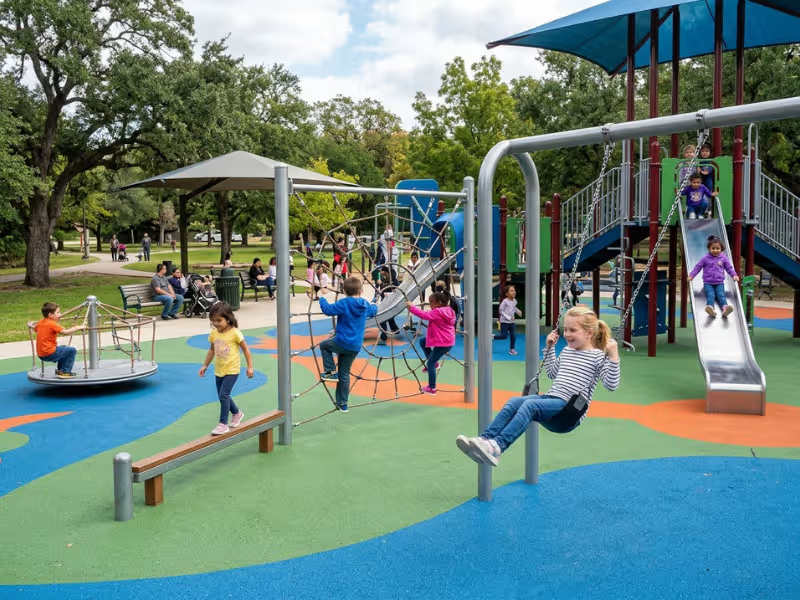
Not all playtime offers the same value. Twenty minutes on a crowded playground with one slide and a long line gives kids far less than twenty minutes in a space that invites them to explore.
The best way to assess a playground or a recess session isn’t the equipment list. Watch the kids. What they do tells you more than any brochure. Here’s what to look for, and what tends to hold kids back.
Signs of High-Quality Play
- Kids make the choices. They pick what to play, who to play with, and when to switch. Kids who drift between activities on their own are a good sign.
- Kids get absorbed. A game often needs 15 minutes or more to take off. Look for kids who forget the clock.
- Bodies move in many ways. A good space invites climbing, swinging, balancing, running, and crawling in a single visit. In larger school or park projects, custom playground equipment can help bring that range into one play environment.
- Some challenge stays within reach. Every child should find something a little hard, like a taller climb, a wobblier beam, or a gap that needs a second look.
- Imagination has room. Open areas, small nooks, and loose parts let a bench become a ship.
- Kids play together. Watch for shared games, turn-taking deals, and older and younger kids mixing.
Signs of Weak Play Environments
Weak play rarely looks dangerous. It usually looks dull, crowded, or over-managed.
- One kind of movement. If the slide is the only option, kids slide, wait, and slide again.
- Too much adult control. Adults assign stations, set every rule, and settle every dispute before kids can try.
- Constant interruption. Whistles, line-ups, and reminders break up play before a game can grow.
- Long lines, short turns. Kids spend more time waiting than moving. Boredom often turns into pushing.
- Nothing to adapt. Fixed equipment with one obvious use leaves no room to invent.
A Quick Comparison
Use this table as a checklist on your next park visit or school walk-through.
|
Sign of high-quality play |
Why it matters |
What weak play environments look like |
|---|---|---|
|
Child choice |
Builds planning and ownership |
Adults assign stations or rotations |
|
Mixed challenge levels |
Every age and skill level finds a next step |
Equipment too easy for older kids or too hard for younger ones |
|
Room for imagination |
Grows language, storytelling, and flexible thinking |
Every piece has one fixed use |
|
Manageable risk |
Teaches kids to judge what they can handle |
All challenge removed, or real hazards like loose bolts and hard ground |
|
Movement variety |
Different moves build different skills |
One slide, one swing, nothing else |
|
Time to get absorbed |
Rich games need time to form |
Short breaks cut off by line-ups |
Try a simple test at your next recess or park visit. Watch for ten minutes and count how many kids are waiting and how many are playing. If waiting wins, the space needs more variety, not more rules.
What Happens When Play Gets Squeezed Out
When schools feel pressure to raise test scores, recess often goes first. It looks like an easy trade: cut 15 minutes of play and add 15 minutes of reading. On paper, kids gain learning time.
In real classrooms, that trade rarely pays off.
The Cost Shows Up in Class
Teachers often notice the change within weeks. Kids fidget more, and small conflicts flare faster. Afternoon lessons drag, and more time goes to getting the room back on track.
Research points the same way. Studies tend to link regular recess with better attention and calmer behavior. They link shorter breaks with more restlessness. Most of this work shows a connection, not proof of cause. Still, the pattern shows up in enough schools to take seriously. When a school says focus has slipped, a good first question is how much free time kids still get.
For Some Kids, Recess Is the Only Playground
Not every child goes home to a backyard or a safe park. Some live in apartments with no outdoor space. Some live where parents don’t feel safe letting kids play outside. Others spend afternoons in childcare or on long bus rides.
For these kids, recess may be the only time all day to run, climb, and play freely with friends. When a school trims recess, it takes the most from the children who have the least. Families with yards and weekend sports can fill the gap. Many families can’t.
A Quick Look at Other Schools
Countries handle break time very differently. In Finland, many schools give students a 15-minute break after each 45-minute lesson, often outdoors in any weather. Kids get to move several times a day.
In the US, recess varies widely by state and district. Many students get a single break of 20 minutes or less. Some lose even that on busy test days.
You don’t need to copy Finland. But the contrast raises a fair question for any school: do kids get enough chances to move and reset? If not, bringing play back may do more for learning than another worksheet.
How Parents and Teachers Can Support Better Play
Better play rarely needs a big budget or a new program. It mostly comes down to a few adult habits: guard the time, stay close but quiet, and know when to step in.
Here’s how that looks at school, at home, and in the tricky moments in between.
At School
Protect recess like a real subject. Put it on the schedule and keep it there, even during test weeks. When recess moves or shrinks “just this once,” kids and staff both learn that it doesn’t count.
Don’t take it away as punishment. The child who loses recess for fidgeting is often the one who needs to move most. Try a different consequence. A short talk at lunch or a small classroom job holds kids accountable without taking away the very thing that helps them settle.
Watch before you step in. Picture two kids arguing over the tire swing. Most adults rush over within seconds. Instead, move close enough to hear and count to thirty. Kids often solve the dispute before the count ends.
Coach the conflict instead of closing it. If the argument keeps going, don’t hand down a ruling. Ask questions:
- “What’s the problem here?”
- “What would be fair to both of you?”
- “Which idea do you want to try?”
Let the kids pick the answer. A rule they invent tends to last longer than one you impose.
Look at what the space is missing. Another slide is rarely the best addition. First, ask what kinds of movement the playground doesn’t offer yet. Is there anything to climb, swing on, balance across, or spin? Fill those gaps first.
Then add loose parts. A shed with old tires, planks, milk crates, and short ropes costs little. Bring it out twice a week, and watch how long kids stay busy.
At Home
Block off open time. Choose one or two afternoons a week with nothing planned. Send the kids outside and resist the urge to fill the first ten minutes. “I’m bored” often comes right before a great game.
Trim the schedule. If every weekday has a lesson, practice, or club, drop one. Kids need time that belongs to them, not just more activities.
Allow risk they can manage. Let your child climb the branch they can reach on their own. Avoid lifting kids onto equipment they can’t climb by themselves. A good rule: if they can’t get up alone, they may not be ready to get down alone.
Stay nearby but keep your hands off. Swap “Be careful!” for questions that build judgment:
- “Where will your foot go next?”
- “Does that branch feel strong?”
- “How will you get down?”
Change the scenery. Rotate between your local park, a different playground, the woods, a beach, or the backyard. A new layout gives kids new problems to solve. The same routine every Saturday soon turns into autopilot.
When Adults Should Step In
Hands-off doesn’t mean eyes-off. Four situations need you right away.
A real safety issue. Act fast on hazards a child can’t see or judge: a broken chain, a loose bolt, a slide too hot to touch in summer, hard ground under a climber, or a hood drawstring that could catch. The same goes for a toddler on a tall platform built for older kids. That’s a mismatch, not a healthy challenge.
The same child left out again and again. One “you can’t play” is part of growing up. A pattern is different. Don’t force the group to include them. Instead, start a game that needs one more player, or give the child a useful role, like timekeeper or base guard.
A conflict kids can’t handle. Step in when hitting starts, when shouting goes in circles, or when one child loses every argument. Separate them briefly. Let everyone cool down. Then coach the problem with the same questions you’d use at school.
A child who’s stuck. Some kids spend all of recess at the edge, watching. They want in but don’t know how. Give them a simple line to try, like “Can I be the next pirate?” You can also start a game next to the group. Others often drift over.
Once play is moving again, step back. The goal is to help kids return to play, not to run it.
Common Objections Parents Raise
Even parents who believe in free play have doubts. The same three concerns come up again and again at school meetings and park visits. Each one makes sense, and each one has a practical answer.
“They’re Just Playing.”
True. And that’s where the learning happens.
Think about how a child learns to share a tire swing. No chart can teach it. She learns by waiting too long, getting upset, and working out a deal with a friend. Next week, she reaches that deal a little faster.
Play isn’t a pause between lessons. For young kids, play is often the lesson itself, in a form their brains and bodies take in easily.
“Playgrounds Are Dangerous.”
Some things on a playground are dangerous. Most of what worries parents isn’t.
A hazard is a risk a child can’t see or judge, such as a cracked weld, a sharp edge, or concrete under a climber. Adults should fix those right away.
A challenge is different. A child looks up at a tall ladder, feels unsure, and decides whether to try. That choice builds judgment.
If you strip out every challenge, kids lose the chance to practice reading risk. Some then go looking for thrills in places with no soft surfacing at all. Scraped knees will happen. Well-built equipment over proper impact surfacing makes serious injuries much less likely.
“My Child Would Rather Be on a Screen.”
Often that’s true. Screens are easy. Outdoor play takes effort to start, especially for a child playing alone.
So lower the effort:
- Keep a ball, chalk, and a scooter by the door.
- Set a regular park time, like Tuesday after school, so nobody has to decide each week.
- Pick a playground close enough to walk to.
Then add people. When friends show up, most kids put the device down. Invite a neighbor along, or meet another family at the park. A child who knows a buddy is waiting rarely argues about leaving the tablet behind.
You don’t need to win a battle with screens. Make outdoor play the easier and more social choice, and many kids will pick it on their own.
FAQs
How much playground time do kids need each day?
Most health guidelines call for at least 60 minutes of moderate to vigorous activity a day for school-age kids. Preschoolers need even more movement, spread across the whole day. Pediatric experts also recommend at least 20 minutes of recess every school day.
Playground time doesn’t need to cover all 60 minutes. Think of it as the part of the day kids run themselves. A 30-minute park stop after school, plus recess, gets most children off to a strong start.
Does recess help academic performance?
Recess doesn’t teach reading or math directly. It helps by putting kids in better shape to learn. After a real break, many children return calmer, more focused, and readier to tackle hard tasks.
If you want to check your school’s approach, ask three questions. How long is recess? Do kids go outside? Do staff ever take it away as punishment? The answers will tell you a lot.
Are risky playground activities good for children?
Yes, when the risk fits the child. Climbing a bit higher or trying a new move teaches kids to judge their own limits.
Keep it in a healthy range:
- Match equipment height to your child’s age and size.
- Let kids climb up on their own instead of lifting them.
- Check for soft impact surfacing under anything they can fall from.
- Stay close enough to see, but let them make the call.
Bumps and scrapes come with the territory. Serious falls usually trace back to poor surfacing or the wrong equipment, not the challenge itself.
What should a developmentally good playground include?
Start with variety. A good playground offers something to climb, swing on, balance across, slide down, and spin on. Then add these features:
- Separate zones for toddlers and older kids, so each group finds the right level of challenge
- Open space for running and chasing games
- Quiet corners where kids can pretend or take a break
- Accessible routes and equipment so children of all abilities can join in
- Clear sightlines so adults can watch without hovering
- Shade and seating so families stay longer
How is free play different from organized sports?
In organized sports, adults set the goals, the rules, and the plan. Kids build teamwork, discipline, and specific skills like passing or dribbling. That has real value.
In free play, kids do all of that work themselves. They choose the game, settle arguments, and change the rules when something feels unfair. Those are different skills, and sports rarely give kids the chance to practice them.
Most children benefit from both. A useful rule of thumb: for every afternoon packed with practices or lessons, protect one afternoon that belongs entirely to your child.
Play Is How Kids Learn
That child on the monkey bars isn’t taking a break from learning. She’s learning with her hands, her judgment, and her friends.
The minutes on the clock matter less than you might think. An hour spent waiting in line teaches little. Twenty absorbed minutes can teach a lot. The best play gives kids four things: the freedom to choose, a challenge within reach, many ways to move, and enough time to get lost in a game.
So start small. This week, watch one playground session without coaching. Don’t fix, cheer, or suggest. Just notice.
Is your child planning a climb? Rewriting a rule? Talking a friend into a new game? Write down one skill you see. You may be surprised by how much they’re already practicing.